



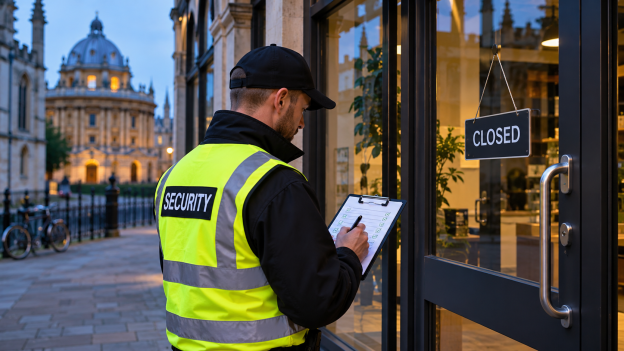
For many businesses, the end of the working day is when security becomes particularly important. Staff leave, doors are locked, lights go off and commercial premises can remain unoccupied for several hours.
Whether you manage a shop in Oxford city centre, an office in Headington or a commercial property in Cowley, having a reliable closing procedure can make a significant difference to the security of your premises.
Unfortunately, everyday mistakes such as leaving a rear entrance unsecured, forgetting to activate an alarm or failing to check a vulnerable access point can expose businesses to unnecessary risks.
The good news is that many of these risks can be reduced through straightforward security measures.
This guide provides a practical closing-time security checklist for Oxford businesses, covering everything from physical security and CCTV to staff responsibilities and overnight protection.
Why Closing-Time Security Matters
Businesses often invest in locks, alarms and CCTV systems but overlook the importance of how these measures are used each day.
A security system is only effective when it is properly maintained and operated.
For example, a business may have an excellent intruder alarm, but if employees regularly forget to activate it, the investment offers little protection outside working hours.
Similarly, CCTV cameras may record activity around a building, but poor lighting, obstructed views or faulty equipment can limit their usefulness.
Oxford presents a particularly varied commercial environment. Businesses range from independent retailers and hospitality venues to offices, educational establishments and specialist commercial facilities.
Each has different vulnerabilities, but the principles of good security remain largely the same.
The aim should be to make your premises more difficult to access unlawfully, reduce opportunities for theft and ensure that suspicious activity can be identified and dealt with appropriately.
1. Check Every Entrance Before Leaving
One of the simplest and most important closing procedures is checking that all entrances are secure.
This includes more than the main entrance.
Rear doors, delivery entrances, fire exits, loading bays and staff access points should all be included in the final inspection.
Businesses should:
- Check that external doors are properly locked.
- Ensure windows are closed and secured.
- Inspect loading bays and delivery entrances.
- Confirm that access-controlled doors have closed correctly.
- Check for visible damage to locks or door frames.
Fire exits must remain compliant with fire safety requirements and allow safe emergency escape when the building is occupied.
For businesses with multiple entrances, a written checklist can help prevent individual access points from being overlooked.
It is also sensible to assign responsibility for the final inspection to a specific employee rather than assuming someone else has completed it.
2. Make Sure Your Alarm System Is Working
An intruder alarm can provide an important additional layer of protection, particularly for businesses that remain unoccupied overnight.
However, alarms need regular testing and maintenance.
Before closing, employees should confirm that the system has been activated correctly and that no faults are showing.
If an alarm cannot be set, the issue should be reported immediately rather than left until the following morning.
Businesses should also consider what happens when an alarm activates.
Who receives the notification? Who is authorised to attend the property? Is there a reliable process for investigating the activation?
These questions are especially important for businesses where the owner or manager lives some distance away.
A clear alarm response procedure can help avoid confusion and unnecessary delays.
3. Review Your CCTV Coverage
CCTV is widely used across commercial premises, but installing cameras is only the beginning.
Business owners should periodically check whether their cameras provide useful coverage of vulnerable areas.
These may include:
- Main entrances and exits.
- Rear access points.
- Car parks and loading areas.
- Storage facilities.
- Areas containing valuable equipment.
Camera positioning and lighting are particularly important. A camera overlooking a poorly lit entrance may not capture the level of detail needed to identify an incident.
Recording equipment should also be checked to ensure that footage is being stored correctly.
Oxford City Council and Thames Valley Police operate a public-space CCTV scheme covering various locations across Oxford. However, businesses should not assume that public cameras provide adequate coverage of their own premises.
Privately operated CCTV must also comply with applicable data protection requirements, including appropriate signage, lawful use and secure handling of recordings.
4. Keep Valuable Equipment and Stock Out of Sight
Opportunistic theft can sometimes be encouraged by valuable items being clearly visible from outside a building.
Retailers should consider moving high-value stock away from display windows when closing.
Offices should avoid leaving laptops, tablets and other portable equipment visible near ground-floor windows.
Businesses with tools, machinery or specialist equipment should ensure that valuable items are stored in appropriately secured areas.
This is particularly relevant for premises where expensive equipment remains on site overnight.
A few minutes spent securing valuable items at the end of the day may help reduce the likelihood of theft and the financial disruption associated with replacing equipment.
5. Pay Attention to External Lighting
Lighting can play an important role in making business premises less attractive to intruders.
Dark entrances, poorly illuminated car parks and concealed access routes can create opportunities for unauthorised activity.
Businesses should review lighting around their buildings, paying particular attention to rear entrances and areas that are not visible from public roads.
Motion-activated lighting may be suitable for some locations, while others may benefit from consistent illumination during certain hours.
The right approach will depend on the building, its surroundings and neighbouring properties.
Lighting should also be maintained regularly. Broken fittings and failed bulbs should be reported and replaced promptly.
6. Establish a Clear Staff Closing Procedure
Security should not depend entirely on one person’s memory.
A written closing procedure helps ensure that essential checks are completed consistently, regardless of who is working.
For example, an Oxford retail business might require the closing supervisor to confirm that:
- All customers have left the premises.
- Cash and valuable items are secured.
- Rear doors and windows are locked.
- CCTV and alarm systems are functioning.
- Non-essential equipment is switched off safely.
- The building has been checked for unusual activity.
- The alarm is activated before departure.
For larger premises, it may be appropriate to use a digital checklist or maintain a closing log.
Employees should also know how to report suspicious activity and who to contact if something appears wrong.
Importantly, staff should never be expected to confront suspected intruders or put themselves at risk.
7. Consider the Risks Around Your Business Location
Not every business in Oxford faces the same security challenges.
A city-centre shop with regular public access will have different priorities from an office building or commercial unit on an industrial estate.
For example, retailers may be particularly concerned about shoplifting, cash handling and the security of stock.
Offices may need to protect IT equipment, confidential documents and restricted areas.
Businesses with deliveries and vehicle access may need additional measures to secure loading areas and prevent unauthorised entry.
Location also matters.
A premises situated along a busy pedestrian route may benefit from natural surveillance during the day but become quieter after closing.
A building with rear access through a service yard may have vulnerabilities that are not immediately obvious from the main entrance.
Business owners should therefore assess their own surroundings rather than relying on a standard approach.
8. Don’t Forget Key Control
Lost keys, duplicated keys and outdated access permissions can create avoidable security problems.
Businesses should maintain an accurate record of who has access to their premises.
When employees leave or contractors complete their work, access permissions should be reviewed.
For traditional locks, this may involve recovering keys or changing locks where necessary.
For electronic access systems, unused cards and access codes should be disabled promptly.
It is also important to consider where spare keys are stored.
Leaving keys in unsecured locations or sharing access codes unnecessarily can undermine otherwise effective security arrangements.
Businesses with several authorised keyholders should have a clear process for managing access and responding to emergencies.
9. Have a Plan for Unexpected Incidents
Even well-protected premises can experience unexpected incidents.
An alarm may activate overnight, a door may be damaged or an employee arriving early may discover signs of a break-in.
Businesses should have a simple response plan that explains what to do in these situations.
The plan should identify:
- Who should be contacted first.
- How an alarm activation should be investigated safely.
- When the police or emergency services should be contacted.
- How incidents should be documented.
- Who is responsible for arranging urgent repairs.
If there are signs of a break-in, staff should avoid entering the building and should contact the police where appropriate.
Employees should not attempt to investigate potentially dangerous situations themselves.
Clear procedures help businesses respond more safely and reduce confusion during stressful circumstances.
10. Consider Additional Overnight Security Measures
For some businesses, physical locks, CCTV and alarm systems may provide an appropriate level of protection.
Others may require additional support.
Premises containing valuable equipment, buildings with repeated security incidents or properties with several vulnerable access points may benefit from professional overnight security arrangements.
Options can include scheduled patrols, professional key holding, alarm response or on-site security personnel.
The most appropriate approach will depend on the property’s risk profile, operating hours and budget.
For example, a smaller office that is empty overnight may not require a permanent security officer but could benefit from an arrangement where trained personnel attend alarm activations.
A larger commercial property may require a more structured approach involving access control, patrols and incident reporting.
Businesses should assess their needs carefully rather than assuming that every property requires the same solution.
Local Crime Prevention Support in Oxford
Oxford businesses can also benefit from advice and support available through local organisations.
Thames Valley Police provides practical guidance on protecting commercial premises against burglary, theft and vandalism.
The Oxford City Crime Partnership also works with local businesses and partner organisations to share information and support crime reduction, particularly within retail and licensed premises.
These resources can help business owners better understand potential risks and improve their existing security arrangements.
Useful resources include:
- Thames Valley Police – Business Crime Prevention
- Oxford City Council – Public Space CCTV
- Oxford City Crime Partnership
How Often Should Businesses Review Their Security?
Security procedures should not be treated as something that is written once and then forgotten.
Business circumstances change.
New employees join, access arrangements are updated, valuable equipment is purchased and buildings undergo alterations.
A security review is particularly worthwhile when:
- A business moves into new premises.
- There has been a break-in or attempted theft.
- Employees with access responsibilities leave.
- Opening hours change.
- New entrances or storage areas are introduced.
- CCTV or alarm equipment is replaced.
Regular reviews can identify weaknesses before they develop into more serious problems.
Even a brief inspection of locks, lighting, alarm procedures and staff responsibilities can be valuable.
Protecting Your Oxford Business Starts With Good Habits
Effective business security is not always about expensive equipment or complicated systems.
In many cases, the most important improvements come from consistent everyday practices.
Checking entrances, activating alarms, securing valuable items and making sure staff understand their responsibilities can all contribute to a safer working environment.
For Oxford businesses, the key is to adopt measures that reflect the individual property, its location and the risks associated with its activities.
Where additional protection is required, professional security support can complement existing procedures.
All Time Security works with organisations across Oxford and Oxfordshire, helping businesses assess and manage their security requirements.
To learn more about the professional support available, visit our security services in Oxford page.
Taking a few extra minutes to secure your premises today could help prevent a much more costly problem tomorrow.
