



Blogs

  • Security guard and security patrol
  • Corporate & Concierge security
  • Construction & Demolition site security
  • Guard Dog security service
  • Key holding & alarm response
  • Lock & unlock building and car park
  • Door supervision & Event security
  • Reception & Front of House Management

Request a Quote

Submit the form below and our team will be in touch shortly.

Monthly Archives: September 2026
Protect your building site with this practical 15-point construction security checklist covering access control, guarding, CCTV, plant protection, mobile patrols and incident response.
Construction Site Security Checklist 15 Ways to Protect a UK Building Site
28 Sep 2026

A practical checklist for clients, principal contractors, site managers and project teams.

Introduction

Construction sites can contain valuable plant, tools, fuel, materials and sensitive project information. They also contain hazards that can cause serious harm if an unauthorised person enters. Effective construction site security therefore protects more than property: it supports public safety, programme continuity and the professional management of the project.

The Health and Safety Executive guidance on protecting the public says construction sites need measures to manage access across defined boundaries and steps to exclude unauthorised people. The right solution will depend on the site, surrounding area, construction phase, operating hours and likely consequences of a breach. This 15-point checklist provides a practical starting point.

1 Complete a site specific security risk assessment

Walk the site and identify likely entry routes, blind spots, public interfaces, scaffolding, neighbouring property and areas that become isolated outside working hours. Record valuable or safety-critical assets, including plant, fuel, cable, tools, devices, keys and hazardous materials. Assess theft, vandalism, arson, trespass and insider risks, then assign an owner to each important control. Review the assessment whenever the layout, programme or stored assets change.

2 Establish a secure perimeter

Use fencing or hoarding appropriate to the location, project duration and public exposure. Remove gaps, secure interfaces with buildings and prevent skips, materials or parked equipment from becoming climbing aids. The HSE public-protection guidance explains that site boundaries should reflect the work and surroundings. Inspect the entire perimeter at opening and closing, after severe weather and whenever deliveries or groundworks may have disturbed it.

3 Control pedestrian and vehicle entrances

Reduce entrances to the minimum practical number and separate pedestrians from vehicles where possible. Workers, visitors and drivers should enter through an authorised point, receive suitable instructions and remain within approved areas. Verify unexpected deliveries rather than relying on confidence or branded clothing. Keep sign-in and pass information current so the site can establish who is present during an incident or evacuation.

4 Match guarding to the actual risk

Professional guards can provide deterrence, gate control, patrols, incident assessment and immediate escalation. Their duties should be based on a current site plan and clear assignment instructions. Define posts, patrol routes, restricted areas, communications and emergency actions. When selecting construction site security services, consider the vulnerable locations and hours that need coverage rather than purchasing a standard shift pattern that may leave important areas unseen.

5 Design CCTV around a response

CCTV should show the activity that matters at gates, compounds, scaffold approaches and vulnerable boundaries. Check lighting, image quality, retention, connectivity, privacy and signage. Decide who receives an alert, how it will be verified and who can attend. Cameras that are blocked by containers, left with incorrect time settings or monitored without an agreed response can create confidence without providing effective protection.

6 Combine lighting alarms and detection

Use lighting to support safe observation and clear camera images without creating glare, deep shadows or unnecessary disturbance to neighbours. Protect alarm power and communication routes, then test the complete notification process. Repeated false alarms should be investigated because they encourage complacency. Detection should lead to a defined decision: remote challenge, manager notification, patrol attendance, guarding response or emergency-service contact, depending on the event.

7 Protect plant tools fuel and materials

Remove keys, activate immobilisers, use secure compounds and consider tracking or recognised security marking. Keep photographs, serial numbers and ownership records. Secured by Design plant-security advice recommends layered measures, including secure overnight storage, physical restraint and tracking. Do not focus only on large machines: batteries, survey equipment, cable, power tools and easily resold components are often simpler to remove and may still disrupt the programme.

8 Control keys locks passes and access devices

Issue keys, fobs and access cards to named people and record their return. Restrict master keys, protect alarm codes and remove permissions when workers leave the project. Never hide spare keys around the site. If a key or card is lost, identify what it can access and act immediately; electronic permissions may need suspending and affected locks or codes may need changing.

9 Use mobile patrols strategically

For some sites and lower-risk periods, mobile security patrols can provide visible, time-stamped checks without a permanent guarding post. Patrol routes should cover real vulnerabilities rather than only the main entrance, and visit times may need variation. Officers require safe access, current instructions and clear escalation. Review patrol reports for repeated defects instead of treating completion of the visit as the only measure of success.

10 Secure scaffolding ladders and work platforms

Scaffolding can provide access to incomplete structures and neighbouring buildings. The HSE safety alert on scaffolding and ladder security recommends a combination of secure perimeter fencing, local protection and ladder removal or suitable ladder guards. Keep materials and skips away from areas where they create climbing aids. Reassess access whenever scaffolding is extended, altered or partly dismantled.

11 Prepare for nights weekends and holidays

Complete a documented lock-up before quiet periods. Check boundaries, gates, cabins, temporary openings, plant, keys, fuel, waste, alarms and emergency contacts. Long shutdowns need additional planning because response may be slower and faults can remain undiscovered. Test communications before a bank holiday and arrange extra patrols or guarding where deliveries, weather, local incidents or the construction phase increase exposure.

12 Reduce arson and fire related risks

Control combustible waste, fuel and ignition sources, and prevent access to vulnerable timber or temporary buildings. Coordinate security checks with the fire plan, hot-work arrangements and emergency access. Guards and responders should know the correct site entrance, address information and escalation route. Security personnel do not replace fire-safety management, but effective closing checks and early detection can reduce the opportunity for deliberate or accidental harm.

13 Protect site offices devices and information

Temporary offices may contain laptops, tablets, drawings, access credentials and personal information. Lock devices and paper files away, use strong authentication and encryption, maintain backups and remove access when roles change. Protect camera and alarm credentials as well. Theft of surveying or IT equipment can expose project data as well as create replacement cost and operational delay.

14 Create an incident and alarm response plan

Define who contacts management, emergency services, the client and insurers. Preserve evidence safely, secure temporary damage and record times, observations, actions and reference numbers. Employees should not be expected to attend a potentially dangerous alarm without suitable arrangements. A professional key holding and alarm response service can provide an agreed attendance route and detailed reporting when it is impractical or unsafe for site personnel to respond.

15 Audit test and improve the plan

Inspect physical measures, test alarms and communications, review access records and walk patrol routes. Track defects, repair times, false alarms, repeated breach locations and completed corrective actions. A falling incident count is not enough on its own; it may also indicate that people have stopped reporting weaknesses. Review the complete plan after any significant incident and before each major construction phase.

Choosing a construction site security provider

Start with the outcome the project needs: access control, public protection, theft prevention, monitoring, patrol, incident response or a combination. Confirm relevant licences using the government SIA licensing guidance, and assess mobilisation, supervision, relief coverage, lone-working controls, reporting and escalation. A provider should be able to explain how its proposed service responds to the actual site risks.

Price matters, but hours are not the same as protection. Compare the areas covered, responsibilities included and management support behind the service. Give the provider accurate plans, working hours, expected changes, authorised contacts and known incidents. Review the arrangement as the project moves from groundworks to structure, fit-out and handover.

Questions to ask before finalising the plan

Can the site account for every entrance, key and access card? Are the most valuable assets protected during the quietest hours? Will an alarm reach somebody who can assess it and attend safely? Can cameras identify activity at the locations that matter? Do guards and patrol officers have current plans, contacts and instructions? Has the closing routine been tested before a long shutdown?

The answers should be supported by evidence rather than assumption. Walk the boundary after dark, test a genuine alarm signal, sample the visitor record and check whether a responder can reach the correct entrance. Ask workers and supervisors where the process is regularly bypassed or difficult to follow. Practical testing often exposes simple weaknesses before they become expensive incidents.

Final construction site security checklist

Before closing the site, confirm that the boundary is intact; entrances are controlled; visitors and vehicles are accountable; guarding, patrols and monitoring match the risk; cameras and alarms work; keys, plant, fuel, tools and information are protected; and emergency contacts can respond. Every defect should have an owner and a deadline.

For help designing a proportionate solution, speak with All Time Security about professional construction site security. ATS can combine guarding, access control, patrols, key holding and alarm response around the site’s location, programme and assessed risks.

Share This:

Oxford skyline illustrating business security services in Oxford
Oxford Business Security Guide 2026: Protecting Commercial Premises Across the City
21 Sep 2026

Oxford is internationally recognised for its universities and historic city centre, but it is also a substantial commercial economy in its own right. Offices, technology businesses, retailers, hospitality venues, research organisations, construction projects, warehouses and residential developments all operate across the city and surrounding areas.

Oxford City Council describes the city as having a diverse business base shaped by its universities, vehicle manufacturing history and significant biomedical, medical and technology sectors. Its figures show thousands of businesses and more than 100,000 jobs within Oxford. Oxford City Council

For organisations operating here, security therefore needs to reflect the environment in which the business actually operates.

A retail premises near Cornmarket Street has very different requirements from a research facility, construction site, office building or industrial unit on the outskirts of the city.

This guide looks at some of the practical security issues Oxford organisations should consider and how a professionally planned security strategy can reduce risk.

For a broader overview of professional guarding, patrols, keyholding and other security services available in Oxford, All Time Security has also produced a dedicated guide to security provision across the city.

Understanding Oxford’s Commercial Environment

Oxford presents an unusual security environment because commercial, educational, residential and visitor activity often exists within the same relatively compact areas.

The city has substantial employment in education and healthcare alongside professional, scientific, technical, financial, IT and business services. Oxford City Council

Oxford City Council also highlights the importance of tourism to the local economy, with millions of daytime and overnight visitors contributing significant expenditure to local businesses. Oxford City Council

That combination creates several considerations for businesses.

High footfall can make access control more difficult. Extended operating hours can increase out-of-hours vulnerability. Public-facing premises may have to manage customers, visitors, contractors and employees simultaneously.

Security therefore works best when it is designed around the individual premises rather than relying on a standard solution.

Start With a Security Risk Assessment

One of the most useful things an Oxford business can do is assess where it is actually vulnerable.

This does not necessarily mean installing more equipment or employing more guards.

It means understanding the risks first.

A practical assessment should consider:

  • entrances and exits
  • staff access
  • visitor access
  • deliveries and loading areas
  • isolated areas of the building
  • valuable equipment or stock
  • CCTV coverage
  • alarm systems
  • opening and closing procedures
  • previous incidents
  • overnight occupancy
  • lone workers
  • car parks
  • perimeter security
  • emergency procedures.

The Health and Safety Executive provides guidance to businesses on identifying and controlling workplace risks, while Oxford City Council also directs local organisations towards HSE risk-assessment guidance. Oxford City Council

For security specifically, the principle is similar: identify the genuine risks before deciding what resources are required.

Oxford City Centre Businesses

Central Oxford combines shops, restaurants, offices, colleges, hotels, entertainment venues and significant pedestrian activity.

Oxford City Council maintains a dedicated City Centre Management programme designed to coordinate businesses, public services and other stakeholders across the centre. Oxford City Council

For businesses operating around areas such as Cornmarket Street, High Street, St Aldate’s, Queen Street, George Street and the surrounding city centre, security planning may need to consider:

  • large numbers of visitors
  • public access
  • shop theft
  • anti-social behaviour
  • unauthorised entry
  • staff safety
  • closing procedures
  • cash handling
  • vulnerable entrances
  • evening activity.

Police.uk provides neighbourhood crime information for Oxford Central, allowing businesses to examine recorded crime around specific streets and areas rather than relying purely on city-wide averages. Police UK

Thames Valley Police also publishes local neighbourhood information and crime mapping for Oxford Central. Thames Valley Police

Businesses should use this kind of local evidence alongside their own incident history when reviewing security arrangements.

Offices and Corporate Buildings

Oxford’s commercial economy extends well beyond retail.

Professional businesses, laboratories, technology companies, consultants and organisations operating from offices have different security priorities.

Their main concern may not be shop theft.

Instead, risk may centre around:

  • unauthorised access
  • sensitive work areas
  • visitor management
  • expensive equipment
  • confidential information
  • contractors
  • staff working late
  • reception security
  • emergency procedures.

A professional security officer in an office environment therefore needs to do more than simply stand at an entrance.

Depending on the site, duties may include reception support, access control, visitor verification, building patrols, incident reporting and liaison with facilities management.

This is where security and customer service increasingly overlap.

An officer may be the first person an employee, customer or visitor encounters when entering a building.

Security for Oxford’s Research and Education Environment

Education and research form an unusually large part of Oxford’s economy.

The University of Oxford itself maintains extensive security infrastructure. Its published security service catalogue includes services such as alarm monitoring, CCTV monitoring, security patrols, incident response, building locking and unlocking and event security. Oxford University

That does not mean every organisation needs the same level of provision.

It does demonstrate how varied the security requirements of large educational and research environments can become.

Private student accommodation, research premises, training organisations and educational buildings may need to consider:

  • safeguarding
  • access control
  • student and visitor movements
  • out-of-hours access
  • laboratories or specialist equipment
  • events
  • residential accommodation
  • incident response.

Security personnel working in these environments also need appropriate communication skills. The objective is to maintain security without unnecessarily disrupting the people who legitimately use the premises.

Construction Site Security in Oxford

Construction sites present another very different risk profile.

Plant, machinery, fuel, tools and building materials may remain onsite overnight while sections of the perimeter can change as work progresses.

Security planning might therefore include:

  • controlled site access
  • perimeter inspections
  • security officers
  • mobile patrols
  • CCTV
  • locking procedures
  • contractor checks
  • alarm response.

Construction security should also change as the project develops.

A site at groundwork stage may have completely different vulnerabilities several months later once buildings, equipment and internal areas have been established.

Regular security reviews are therefore important.

Retail and Hospitality Security

Oxford’s visitor economy means retail and hospitality businesses operate within some of the busiest parts of the city.

Security in these environments needs to remain proportionate.

Customers should not feel as though they are entering a fortress, but employees and property still need protection.

Depending on the premises, appropriate measures might include CCTV, staff procedures, appropriately positioned security officers, monitored entrances, incident reporting and clearly defined escalation procedures.

Visible security can also have a customer-service function when officers are trained to interact professionally with the public.

Mobile Security Patrols for Oxford Businesses

Not every organisation needs a permanent security officer.

For some premises, scheduled or irregular mobile patrols may provide a more appropriate level of protection.

A patrol officer might check:

  • entrances
  • windows
  • gates
  • perimeter fencing
  • fire exits
  • suspicious activity
  • signs of attempted entry
  • alarm status.

This can be particularly useful for businesses that are primarily vulnerable overnight or during weekends.

Businesses considering this type of protection can learn more about the different approaches included within All Time Security’s wider guide to professional security services in Oxford.

Keyholding and Alarm Response

One of the most overlooked security questions is what happens after an alarm activates.

If the responsibility falls on a manager or member of staff, that person may need to attend a premises alone, sometimes during the night, without knowing why the alarm has activated.

Professional keyholding and alarm-response arrangements can transfer that responsibility to trained security personnel.

Depending on the arrangement, a security company can attend the property, inspect the premises and escalate the incident appropriately.

This can form part of a wider out-of-hours security plan rather than operating as an isolated service.

Security Should Be Layered

Strong security rarely depends on one measure.

For example, CCTV may record an incident but cannot physically challenge an intruder.

A security officer can respond to activity but cannot observe every location simultaneously.

An alarm can notify someone that something has happened but needs an effective response procedure behind it.

A stronger system may combine:

Physical security + people + technology + procedures.

For example:

CCTV identifies suspicious activity → an alarm or monitoring system raises the alert → a security officer investigates → the incident is recorded → management reviews what happened.

The combination is often more useful than relying on any one measure independently.

Review Security When the Business Changes

Security arrangements should not remain unchanged simply because they have worked previously.

Review them whenever there is a significant operational change.

Examples include:

  • moving premises
  • expanding a building
  • increasing employee numbers
  • extending opening hours
  • taking on additional stock
  • beginning construction work
  • introducing new access points
  • experiencing repeated incidents.

Oxford itself is also continually developing.

The City Council’s current business strategy places emphasis on economic growth, business development and further investment across the city. Oxford City Council

As commercial environments change, security requirements can change with them.

Choosing a Security Company in Oxford

Businesses comparing security companies should look beyond price alone.

Questions worth asking include:

  • Are the officers appropriately licensed?
  • How are officers vetted?
  • Who supervises them?
  • What happens when an officer is absent?
  • Is there a control room?
  • How are incidents reported?
  • Can the company provide both permanent and temporary cover?
  • Can security arrangements be adjusted as the site changes?
  • Does the provider understand the type of premises being protected?

The most effective arrangement is usually one designed around the organisation rather than simply selecting a standard package.

All Time Security provides security guarding and related protection services for businesses across Oxford and Oxfordshire. You can find more information in our dedicated guide to security services in Oxford and the surrounding area.

Areas Around Oxford

Security requirements extend beyond Oxford city centre.

Businesses operating across areas including Headington, Cowley, Summertown, Botley, Marston, Wolvercote and Littlemore, as well as the wider Oxfordshire area, can face very different environments and operating conditions.

Industrial premises and business parks may prioritise perimeter protection and overnight security.

Retail locations may prioritise theft prevention and public interaction.

Residential developments may need concierge-style security and access management.

Construction projects may require temporary but intensive security.

The important point is that the location alone does not determine the solution.

The premises, operating hours, people and assets at risk matter just as much.

A Practical Oxford Business Security Checklist

Oxford businesses reviewing their security can start with these ten questions:

  1. Who can enter the premises?
  2. Are all entrances properly controlled?
  3. Who is responsible for opening and closing?
  4. What happens if an alarm activates at 2am?
  5. Are there areas CCTV cannot see?
  6. Are valuable assets visible or easily accessible?
  7. Are staff trained to respond to incidents?
  8. Are contractors and visitors properly recorded?
  9. Has the business experienced previous security incidents?
  10. When was the security arrangement last reviewed?

If any of those questions cannot be answered confidently, it may be worth carrying out a more detailed assessment.

Protecting Businesses Across Oxford

Oxford is not one single security environment.

A city-centre retailer, Headington healthcare facility, Cowley commercial premises, student accommodation development and construction site can all require completely different approaches.

The strongest security strategies reflect those differences.

For organisations reviewing their arrangements, the starting point should be understanding the actual risks, identifying where existing protection is weak and selecting measures that address those vulnerabilities.

All Time Security provides guarding, mobile patrols, keyholding, alarm response and other commercial security solutions across Oxford.

For more information, read our complete guide to securing Oxford with professional security services or contact All Time Security to discuss requirements for your premises.

Share This:

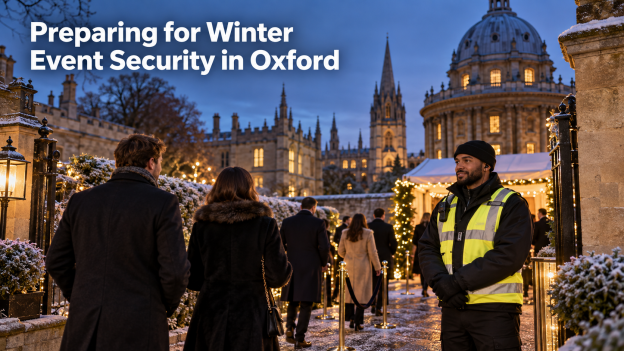
Winter Event Security in Oxford - All Time Security
From Lidos to Christmas Lights: Preparing for Safe and Secure Winter Events in Oxford
17 Sep 2026

From Lidos to Christmas Lights: Preparing for Safe and Secure Winter Events in Oxford

After a busy summer helping to keep lidos, outdoor events, parties and private functions safe, the team at All Time Security is preparing for the next chapter in Oxford’s events calendar.

And what a summer it has been.

Our security teams have spent long, warm days working around swimming pools and lidos, welcoming guests to private celebrations, supporting busy public events and helping organisers create places where people can relax and enjoy themselves. There have been early starts, late finishes, packed venues, excited crowds and plenty of sunshine.

For most visitors, a successful event is simply one they enjoyed. For the security team, success often means something much quieter: problems were prevented, guests felt welcome, organisers felt supported and the security operation blended into the background.

That is always our aim.

As summer gives way to autumn, however, the work does not stop. The atmosphere changes, the evenings become darker and a new season of events begins. Oxford and the surrounding area will soon be busy with university functions, autumn festivals, Bonfire Night displays, Christmas markets, corporate parties, winter weddings and end-of-year celebrations.

These events bring their own energy—and their own security challenges.

For organisers looking for dependable event security in Oxford, now is the right time to begin planning. Good security should never be a last-minute addition. It should be part of the event from the beginning, shaped around the venue, audience, timings and character of the occasion.

Looking Back on a Brilliant Summer

This summer reminded us why we enjoy event security so much.

Every event is different. A busy lido on a hot afternoon requires a different approach from a private evening function. A family event needs a different style of communication from a late-night party. A community celebration may have open access and visitors arriving from several directions, while a ticketed event may depend on controlled entry, guest-list management and bag searches.

Our officers have had to be observant, approachable and adaptable. They have answered questions, guided visitors, monitored entrances, supported venue staff and stepped in calmly when situations needed attention.

Lido security was a particularly important part of the summer. When temperatures rise, swimming pools and outdoor leisure venues can become extremely busy very quickly. Security in that setting is not about making a family day out feel restrictive. It is about supporting staff, managing capacity, protecting restricted areas, dealing with unsafe or antisocial behaviour and helping everyone enjoy the facility responsibly.

The best security officers understand the atmosphere they are working in. At a lido, they may be giving directions to families one moment and responding to a developing concern the next. At a private party, they may welcome guests, discreetly check invitations and help someone find a taxi at the end of the evening. At a public event, they may monitor crowd movement, keep emergency routes clear and communicate constantly with organisers.

Those experiences will travel with us into the winter season.

Summer may be brighter and warmer, but the fundamentals do not change: preparation, communication, professionalism and a genuine concern for people.

Winter Events Bring Different Risks

Oxford does winter events brilliantly. Historic streets, university buildings, hotels, community venues and country estates provide memorable settings for Christmas celebrations, dinners, markets, performances and private functions.

Winter also makes security planning more complicated.

Darkness arrives earlier. Wet leaves, rain, frost and occasionally snow can affect entrances, walkways and outdoor areas. Guests tend to arrive wearing coats and carrying umbrellas or bags. Temporary lighting and heating equipment may be needed. Deliveries, contractors and entertainers can all require access before an event opens.

Alcohol is also more likely to play a prominent role at Christmas parties and end-of-year celebrations. People may arrive in large groups, stay later than expected and leave at roughly the same time. Transport delays or shortages can then result in guests waiting outside the venue.

None of these issues makes an event unsafe by default. They simply need to be anticipated.

An effective winter event security plan should consider the entire guest journey: approaching the venue, entering, moving around inside, using any outdoor spaces and leaving safely at the end of the night.

Start With the Venue, Not a Generic Checklist

Security planning works best when it begins with the actual venue.

Oxford’s buildings are wonderfully varied. A city-centre venue may have limited vehicle access and several neighbouring businesses. A historic college or listed property may have narrow entrances, internal courtyards and restrictions on temporary equipment. A rural venue outside Oxford may have more space but fewer transport options and darker surrounding roads.

That is why we prefer to understand an event before recommending the security arrangements.

How many guests are expected? Is the event invitation-only, ticketed or open to the public? Will alcohol be served? Are under-18s attending? Are there multiple entrances? Will any VIPs be present? What time are suppliers arriving? Where will guests queue? How will the venue manage somebody who is refused entry? What happens if severe weather affects an outdoor area?

These are practical questions rather than paperwork for its own sake.

Oxford City Council’s Safety Advisory Group guidance explains that organisers remain responsible for conducting their events safely. It also identifies the kinds of occasions that may need additional consideration, including outdoor entertainment, firework displays and large company parties.

The earlier these conversations take place, the more useful the security team can be.

Think Carefully About Arrival and Entry

The entrance often determines the mood of an event.

Guests do not want to arrive at a Christmas party and be met with confusion, an unexplained queue or an unnecessarily confrontational welcome. At the same time, organisers need to know that only authorised people can enter and that admission policies are applied consistently.

Professional door supervisors in Oxford can support guest-list checks, ticket scanning, age verification, searches and capacity control where required. Just as importantly, they can provide a calm and helpful first point of contact.

Good entry management should answer several questions before the doors open:

  • Where will the queue form?
  • Will it obstruct a pavement, road, fire exit or neighbouring entrance?
  • Is the waiting area adequately lit?
  • Can guests with reduced mobility enter comfortably?
  • Who makes the final decision when admission is refused?
  • Where should a difficult conversation take place without holding up the entire queue?
  • How will staff distinguish guests from contractors, performers and suppliers?

On a cold or wet night, queue management becomes even more important. People are less patient when they are standing in heavy rain. A clearly briefed team, visible signage and an efficient admission process can prevent frustration from becoming a security issue.

Plan for Crowds Indoors and Outside

Crowd management does not begin when a venue feels full. It begins with understanding capacity, movement and potential pressure points.

Entrances, cloakrooms, bars, staircases, smoking areas and toilets can all become congested. A Christmas market or public celebration may also have queues at individual stalls, temporary structures and pedestrian routes crossing delivery or vehicle areas.

Security officers need to know where people are likely to gather and how that could change during the event.

At an evening function, for example, the cloakroom may be quiet at 8pm but overwhelmed when everyone leaves after midnight. At a fireworks display, the audience may arrive gradually but attempt to leave almost at once. At a university or corporate celebration, speeches or entertainment can cause sudden movement between rooms.

A good plan considers those patterns in advance. Positioning trained staff at the right locations can keep routes open, identify problems early and help guests move safely without making the event feel over-managed.

Winter Weather Is a Security Consideration Too

Security and safety overlap constantly during winter.

Poor lighting can make it harder to identify hazards or monitor a perimeter. Rainwater can create slippery entrances. Strong winds may affect signs, barriers, gazebos and temporary structures. Ice can turn a quiet pathway into a serious risk. Cold weather can also affect guests waiting for transport after an event.

Organisers should monitor forecasts and establish who has authority to alter or stop an activity if conditions deteriorate. Outdoor areas may need additional lighting, matting, barriers or patrols. Emergency routes must remain accessible regardless of the weather.

The Oxfordshire Fire and Rescue Service’s winter safety information is a useful starting point for seasonal preparation, while event-specific risks should be recorded in the organiser’s own assessment.

Security personnel should be included in those discussions. Officers positioned around the venue are often among the first people to notice that a walkway has become slippery, a temporary barrier has moved or guests are gathering somewhere they should not.

Christmas Parties Need More Than Someone Standing at the Door

Corporate Christmas parties and private functions are meant to be enjoyable. The presence of professional security should support that atmosphere, not work against it.

The most effective officers combine awareness with good judgement. They know when a friendly conversation is enough, when venue management should be informed and when firmer action is necessary.

Alcohol can change the mood of an event, particularly towards the end of the night. Small disagreements can escalate, unattended drinks can create welfare concerns and guests may attempt to enter areas that are closed to the public.

A well-briefed security team can help by:

  • Monitoring behaviour without intruding on the occasion
  • Supporting venue staff when service is refused
  • Responding early to conflict or harassment
  • Protecting staff, guests and restricted areas
  • Helping vulnerable guests reach friends, transport or appropriate assistance
  • Managing closing time and dispersal calmly
  • Recording incidents accurately

This is where experience matters. Heavy-handed security can damage an event. Passive security can allow an avoidable issue to become serious. The right approach is professional, proportionate and focused on preventing problems wherever possible.

Communication Holds the Whole Plan Together

Even a strong security plan can fail if nobody knows how it works.

Before an event opens, the organiser, venue manager, security supervisor and relevant contractors should understand who is responsible for what. Radio channels or contact numbers should be confirmed. Staff should know how to report a concern, request first aid, respond to a lost child or vulnerable person and begin an evacuation if required.

Simple details matter. What name is being used for each entrance? Where is the incident log kept? Who can authorise access to a restricted area? Who contacts the emergency services? Where should staff assemble if the building is evacuated?

The University of Oxford’s event security guidance recommends treating the security plan as an integral part of event planning. It also highlights the value of clear roles, escalation procedures, emergency arrangements and post-event reviews.

That approach applies far beyond university events. Good communication helps every team work as one.

Use Properly Licensed Security Personnel

Price will always matter when organising an event, but security should not be selected on price alone.

Some activities legally require appropriately licensed personnel. Organisers should understand which roles need an SIA licence and confirm that the supplier and officers are suitable for the work being carried out. The Security Industry Authority provides official guidance on security at events, including the checks organisers and suppliers should make before, during and after an event.

All Time Security is an SIA Approved Contractor for door supervision, security guarding and key holding. Our status can be checked on the official SIA register of approved contractors.

For clients, that provides added reassurance that they are working with a professional security company whose systems and standards have been independently assessed.

Local Knowledge Makes a Difference in Oxford

Oxford presents a distinctive mixture of security requirements.

The city combines historic buildings, busy shopping areas, university and college sites, hotels, research facilities, nightlife venues and residential streets. Road access can be limited, large student populations change throughout the year and major events may bring visitors into already busy areas.

Local planning needs to account for the setting as well as the event itself.

A venue in Oxford city centre may require careful queue placement and a clear plan for taxis and collection vehicles. A celebration in Cowley or Headington may need coordination with nearby businesses or residents. A function in Summertown may involve different arrival patterns from an event at a rural Oxfordshire estate.

As a provider of security services across Oxford, All Time Security can build arrangements around the venue rather than applying the same template everywhere.

We can support events with security personnel, stewarding, marshals, front-of-house services and risk assessments. Where appropriate, we can also assist with traffic management, event safety planning and Safety Advisory Group meetings.

Our Winter Event Security Checklist

If you are currently preparing a winter event in Oxford or Oxfordshire, these are some of the questions worth answering now:

  1. Have you completed an event-specific security and safety risk assessment?
  2. Are the expected attendance and safe venue capacity clearly understood?
  3. Are all entrances, exits and emergency routes identified?
  4. Is there a plan for queues in rain, cold weather or darkness?
  5. Are outdoor areas, car parks and pedestrian routes adequately lit?
  6. Do temporary structures and barriers have bad-weather arrangements?
  7. Are guest-list, ticketing, search and age-verification procedures clear?
  8. Will the event require SIA-licensed door supervisors?
  9. Have alcohol-related risks and vulnerable-person procedures been considered?
  10. Is there a clear communication and escalation structure?
  11. Have first aid, fire safety and evacuation responsibilities been assigned?
  12. Is there a plan for closing time, taxis and safe dispersal?
  13. Do security officers know the venue before guests arrive?
  14. Has somebody been given authority to make decisions if weather or attendance changes?
  15. Will a short post-event debrief be held to record lessons for next time?

If several answers are still uncertain, that is not a reason to panic. It is simply a sign that now is the right time to talk to an experienced event security provider.

Ready for the Season Ahead

We are proud of the summer our team has had.

From lively lidos and outdoor gatherings to parties and private functions, our officers have helped create safe, welcoming environments in which people could enjoy themselves. We have met brilliant organisers, worked alongside hardworking venue teams and seen first-hand how much care goes into producing a successful event.

Now we are looking ahead.

Oxford’s winter calendar will bring Christmas parties, formal dinners, festive markets, performances, university events and community celebrations. Behind every memorable occasion will be people opening venues, checking equipment, welcoming guests, monitoring crowds and staying alert long after the music begins.

All Time Security is ready to be part of that team.

If you are planning a winter event and need professional security guards, stewards or door supervisors in Oxford, speak to us before the final details are fixed. We will take the time to understand the venue, the audience and the experience you want to create.

Visit our Oxford event security service, contact All Time Security for a tailored quotation, call 01494 511222, or email info@alltimesecurity.co.uk.

Let’s make this winter’s events memorable for all the right reasons.

Share This:

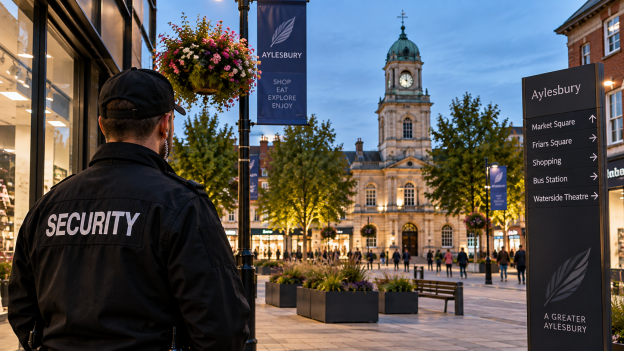
Business Security in Aylesbury: How to Protect Your Premises in 2026
Business Security in Aylesbury: A Practical Guide for Local Companies in 2026
08 Sep 2026

Aylesbury is changing quickly.

New homes are being built, the town centre is being regenerated, commercial areas are expanding and more people are living, working and travelling through the town. For local businesses, that growth brings opportunity — but it can also create new security challenges.

A security plan that worked five years ago may no longer be enough for a business that has expanded, moved premises, increased opening hours or started holding more valuable stock.

The question for Aylesbury businesses is therefore not simply:

“Do we have security?”

It is:

“Does our security still match the way our business operates today?”

For many organisations, reviewing security does not necessarily mean adding more guards or installing more equipment. It means understanding the risks around the premises and choosing the right combination of people, procedures and technology.

This guide looks at some of the main security issues businesses in Aylesbury should consider in 2026.

Aylesbury is growing

Aylesbury is the county town of Buckinghamshire and has a population of more than 90,000 people. Buckinghamshire Council says the wider Garden Town programme is supporting substantial future growth, including plans for around 16,000 new homes by 2033. Buckinghamshire Council

The council is also continuing with major regeneration projects designed to improve the town centre and encourage new investment.

Businesses can read more about the plans through Buckinghamshire Council’s Aylesbury regeneration programme.

Projects include improvements to streets and public spaces, new residential development and the ongoing Pavilion Quarter regeneration. The council says the Pavilion Quarter is intended to create a new cultural and entertainment district with space for small businesses, events and improved connections through the town centre. Buckinghamshire Council

Recent regeneration has also included the conversion of the former county council offices into 46 new town-centre apartments, alongside work on the Pavilion Quarter and pedestrianisation of Cambridge Street. Buckinghamshire Council

All of this means more development, more construction, more businesses and more movement through Aylesbury.

Security arrangements need to evolve alongside that growth.

What does crime look like in Aylesbury town centre?

Security decisions should never be based on fear or exaggerated crime statistics.

However, looking at official local crime data can help businesses understand the types of incidents being reported around them.

According to the latest available Police.uk statistics for Aylesbury Town Centre, 123 crimes were recorded during July 2026. Police.uk

The most commonly reported categories were:

  • 43 violence and sexual offences
  • 18 shoplifting offences
  • 17 public order offences
  • 13 anti-social behaviour incidents
  • 10 criminal damage and arson offences
  • 8 other theft offences

Crime levels also varied across the previous 12 months, from 112 offences in December 2025 and January 2026 to 167 in March 2026. Police.uk

These figures do not mean every Aylesbury business faces the same level of risk.

A retailer in the town centre will have different concerns from a warehouse, office, construction site or residential development.

The important thing is to understand the risks that apply to your specific premises.

1. Retail security in Aylesbury

Shoplifting is one of the more visible security concerns for retailers.

Police.uk recorded 18 shoplifting offences in Aylesbury Town Centre during July 2026, making it the second most commonly recorded category that month. Police.uk

Retail security is not only about catching somebody after an item has been stolen.

A good approach should also consider:

  • visible deterrence
  • entrance monitoring
  • suspicious behaviour
  • staff safety
  • CCTV
  • repeat offenders
  • incident reporting
  • safe handling of confrontation
  • communication with police

A professional security officer can provide a visible presence while still allowing genuine customers to feel welcome.

This balance matters.

An officer who behaves aggressively towards everyone entering a shop may damage the customer experience. Equally, a security presence that is completely passive may provide little deterrent.

For retailers in Aylesbury, particularly around busy shopping and town-centre areas, security should combine observation, customer service and proportionate intervention.

2. Construction site security as Aylesbury develops

Aylesbury’s continued growth also means ongoing construction and redevelopment.

Construction sites can become attractive targets once workers leave because tools, plant, fuel, copper, machinery and building materials may remain unattended.

The council’s regeneration programme includes major projects around the town centre, while the wider Garden Town plans anticipate significant new development. Buckinghamshire Council

Construction companies should consider questions such as:

  • How many entrances does the site have?
  • Who controls contractor access?
  • Are deliveries recorded?
  • What happens after workers leave?
  • Is plant immobilised?
  • Can someone enter through fencing without being seen?
  • Is CCTV monitored?
  • Who responds if an alarm activates?
  • Are high-value materials stored securely?

For larger or higher-risk projects, professional construction site security can provide static guarding, access control, perimeter patrols and overnight protection.

All Time Security also supports construction sites with monitored patrol arrangements and a 24-hour control room. All Time Security

The key is to build security into the project rather than waiting until theft or vandalism has already taken place.

3. Industrial and warehouse security

Aylesbury is not only a town-centre economy.

There are industrial estates, distribution operations, workshops and commercial sites across the wider area.

These premises often face very different security risks.

A warehouse may hold significant amounts of stock but have very few employees present overnight. An industrial unit may have expensive machinery visible from outside. A logistics operation may have dozens of vehicles, drivers and contractors moving through the site.

Useful controls can include:

  • gatehouse security
  • vehicle checks
  • contractor records
  • controlled access
  • perimeter patrols
  • CCTV
  • lighting
  • key control
  • alarm response
  • overnight guarding

Our commercial security services can combine several of these measures depending on the site and operating requirements. All Time Security

One of the biggest mistakes businesses can make is assuming that because a site is busy during the day, it is equally secure at night.

Often the opposite is true.

4. Check what happens after normal business hours

For many Aylesbury businesses, the highest-risk period begins when most employees leave.

At 2pm, there may be dozens of people around.

At 2am, there may be nobody.

Ask what happens then.

Who checks the rear entrance?

Who notices if a gate is open?

Who sees someone walking around the car park?

Who attends if the alarm activates?

Who deals with a broken window?

Many businesses still rely on a manager or employee to attend alarms during the night.

That can place someone in an unnecessary situation where they have no idea what they will find when they arrive.

Key holding and alarm response can transfer that responsibility to trained security personnel.

Mobile patrols can also provide an alternative where a permanent overnight guard is unnecessary.

Our security patrol service can include internal and external checks, higher-risk areas and mobile visits supported by a 24-hour control room. All Time Security

For many smaller commercial sites, this can provide a practical middle ground between having no physical security and paying for a permanent officer throughout the night.

5. Access control is often the real weakness

Some businesses spend thousands on CCTV and alarms but leave basic access procedures weak.

Consider how many different people may enter a commercial premises during an ordinary week:

  • employees
  • customers
  • cleaners
  • delivery drivers
  • contractors
  • engineers
  • temporary staff
  • maintenance teams
  • visitors

If there is no clear system, it can become difficult to distinguish between somebody who should be there and somebody who should not.

Access control does not have to mean creating an intimidating environment.

It may simply involve:

  • one controlled entrance
  • visitor sign-in
  • contractor passes
  • staff ID
  • reception security
  • access cards
  • clear restricted areas
  • better key management

For offices, professional buildings and customer-facing sites, a security officer can often combine access control with reception or concierge duties.

That gives the business both security and a professional first point of contact.

6. Do not treat CCTV as the entire security plan

CCTV remains one of the most useful security tools available to businesses.

But a camera can only do so much.

It may record somebody stealing stock.

It may record someone climbing a fence.

It may record someone entering a restricted area.

But what happens next?

Businesses should review:

  • camera positioning
  • blind spots
  • image quality
  • nighttime visibility
  • retention of footage
  • monitoring
  • who has access
  • how incidents are reported
  • how police requests are handled

CCTV is most effective when combined with a clear response.

That response could come from an employee, monitoring centre, mobile patrol or on-site security officer.

Aylesbury businesses should therefore think about CCTV as one layer of security rather than the whole solution.

7. Pay attention to the risks staff are actually reporting

Employees often know where security weaknesses are long before senior management does.

They may know that a particular rear door is regularly left open.

They may know that someone keeps entering the car park at night.

Retail employees may know which periods attract the most shoplifting.

Reception staff may regularly experience aggressive behaviour.

Warehouse employees may know that certain areas cannot be seen by CCTV.

These observations are valuable.

A security review should therefore include conversations with staff rather than relying solely on equipment or management assumptions.

The latest town-centre data shows that alongside shoplifting, public order, anti-social behaviour and violence-related offences all feature among the more commonly recorded categories locally. Police.uk

For customer-facing businesses, staff safety should therefore form part of the security assessment.

8. Look for patterns rather than isolated incidents

Suppose a business has six security incidents in six months.

That information alone is useful, but not particularly powerful.

Now imagine the business discovers that five occurred between 7pm and 9pm near the same entrance.

That changes the picture completely.

Businesses should record:

  • date
  • time
  • location
  • incident type
  • people involved
  • response
  • outcome

Over time, patterns may emerge.

It might show that patrols should be moved.

A camera may need repositioning.

Access arrangements might need changing.

More staff may be needed for a particular period.

The point is to use security information to prevent the next incident rather than simply document the previous one.

9. Aylesbury businesses should prepare for continued growth

Buckinghamshire Council says Aylesbury currently has around 37,000 jobs, with approximately 2,585 businesses recorded in the town in 2021. Major employment sectors include health, business administration and support services, public administration and defence, and education. Buckinghamshire Council

That diversity is important from a security perspective.

There is no single “Aylesbury security solution”.

A school has different requirements from a warehouse.

A construction site has different risks from a shop.

A residential development needs something different from a corporate office.

As the town grows, businesses should make sure their security arrangements continue to reflect:

  • premises size
  • employee numbers
  • opening hours
  • value of stock
  • visitor volumes
  • location
  • previous incidents
  • lone working
  • out-of-hours activity

Security should change when the business changes.

10. What type of security does your Aylesbury business actually need?

Not every premises needs a permanent security guard.

And not every premises can be protected effectively by CCTV alone.

The answer may be a combination.

Security guarding

Suitable where a continuous human presence is required for access control, patrols, customer safety or incident response.

Mobile patrols

Useful for businesses that need physical checks but not a permanently stationed officer.

Key holding and alarm response

Suitable where businesses want trained personnel to deal with overnight alarm activations rather than calling employees.

Construction security

Designed around access control, equipment protection and out-of-hours risks on development sites.

Reception and concierge security

Useful for offices, residential developments and professional environments where security and customer service need to work together.

Retail security

Focused on deterrence, shoplifting, customer incidents and protecting employees and stock.

The starting point should always be the risk rather than the service.

Choosing a security company in Aylesbury

If you are searching online for a security company in Aylesbury or security guards in Aylesbury, price will naturally be part of the decision.

But it should not be the only consideration.

Ask potential providers:

  • Are officers SIA licensed?
  • How are staff vetted?
  • Is there 24-hour operational support?
  • What happens if an officer is sick?
  • How are patrols monitored?
  • How are incidents reported?
  • Will somebody visit the site before the service begins?
  • Is the solution tailored to the premises?
  • Who manages the contract?
  • How quickly can problems be escalated?

Security only delivers value if it works when you actually need it.

A cheaper service that repeatedly misses patrols, sends unfamiliar officers or cannot respond when something goes wrong can become far more expensive in the long term.

Security should support Aylesbury businesses, not get in their way

The best security is often noticeable to potential offenders but almost invisible to normal business operations.

Employees feel safer.

Visitors know where to go.

Contractors are properly checked.

Doors are controlled.

Incidents are recorded.

Managers know who to call.

And the business continues operating normally.

With Aylesbury continuing to grow and regenerate, businesses should periodically ask whether their current security arrangements still match the premises they operate today.

That does not automatically mean spending more.

It means looking at the site properly, identifying the genuine risks and choosing proportionate measures to reduce them.

For businesses that need professional support, All Time Security provides security guarding, mobile patrols, construction security, commercial security and other security services in Aylesbury and across Buckinghamshire.

If you are reviewing security at an office, warehouse, construction site, shop or commercial premises in Aylesbury, the first step is simply to identify where your current vulnerabilities are.

From there, the right security solution becomes much easier to determine.

Share This:

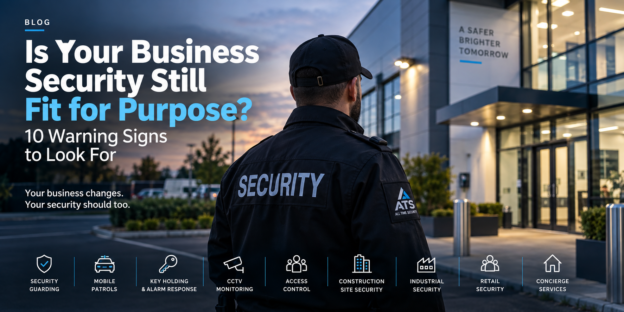
Is Your Business Security Still Fit for Purpose? 10 Warning Signs to Look For
10 Signs Your Business Has Outgrown Its Current Security Arrangements
06 Sep 2026

Is Your Business Security Still Fit for Purpose? 10 Warning Signs to Look For

Security arrangements often grow gradually. A business installs CCTV after one incident, adds an alarm a few years later, introduces access control when it expands and perhaps brings in security officers when problems become more frequent.

The difficulty is that businesses change faster than their security arrangements.

More employees arrive. Buildings expand. Opening hours change. Stock becomes more valuable. More contractors come and go. Staff begin working alone or outside normal hours. Yet the security plan may still be based on how the business operated several years ago.

That is why security should be reviewed regularly rather than only after something goes wrong.

Official guidance from ProtectUK recommends identifying the people, assets, information and processes that need protecting, understanding vulnerabilities and then introducing security measures that are proportionate to the risks faced by the organisation. ProtectUK

Here are ten signs that your business may have outgrown its current security arrangements.

1. Security incidents are becoming more frequent

One incident does not necessarily mean that an entire security strategy needs changing.

A pattern of incidents is different.

Repeated theft, vandalism, trespassing, anti-social behaviour, attempted break-ins or aggressive behaviour should prompt a review of what is happening and why.

Do not look at incidents individually. Look for patterns.

Are they happening:

  • at the same time?
  • in the same location?
  • during shift changes?
  • when fewer staff are present?
  • around particular entrances?
  • after the premises closes?
  • when deliveries are taking place?

Good incident reporting can turn isolated events into useful intelligence.

If five incidents have occurred near the rear entrance during evening hours, the answer may not necessarily be more security everywhere. A change to patrol times, lighting, access arrangements or CCTV coverage may address the actual weakness.

ProtectUK advises organisations to understand their threats and vulnerabilities before deciding which security measures are appropriate. ProtectUK

Read ProtectUK’s guidance on physical security

2. Your staff no longer feel safe

Employees will often notice changes before management does.

Perhaps staff are uncomfortable leaving the building at night. Reception employees regularly deal with aggressive visitors. Warehouse staff have noticed people entering areas where they should not be. Lone workers feel vulnerable during quieter hours.

These concerns should not be dismissed simply because a serious incident has not yet occurred.

The Health and Safety Executive makes clear that employers have responsibilities to assess and manage risks from workplace violence and aggression. This includes verbal abuse and threats, not just physical assaults. HSE

Speaking to employees can also reveal risks that would not necessarily appear during a standard inspection. HSE specifically recommends asking workers about their experiences when assessing workplace violence risks. HSE

If staff are routinely modifying their behaviour because they feel unsafe, security arrangements deserve another look.

HSE guidance on violence and aggression at work

3. Too many people can enter without anyone knowing why they are there

Visitor management is one of the simplest areas of security to overlook.

Ask yourself a straightforward question:

If somebody unfamiliar walked into your premises tomorrow, how far could they get before someone challenged them?

In a busy office, warehouse, construction site, school, residential building or industrial facility, contractors, suppliers and visitors may arrive throughout the day.

Without clear procedures, legitimate activity can make unauthorised access easier to disguise.

A stronger system might involve:

  • controlled entrances
  • visitor signing-in procedures
  • identification
  • temporary passes
  • reception or concierge security
  • contractor records
  • restricted areas
  • clear staff responsibilities for challenging unknown visitors

Physical security works best in layers rather than relying on one measure. ProtectUK describes this as a defence-in-depth approach, where several measures work together rather than depending on a single barrier. ProtectUK

The objective is not to make a workplace uncomfortable. It is to make it harder for somebody to enter areas where they have no legitimate reason to be.

4. Your CCTV records incidents but does little to prevent them

CCTV is extremely useful, but cameras alone are not a complete security strategy.

If management repeatedly watches footage after theft, damage or intrusion has occurred, CCTV may be functioning primarily as an evidence system rather than a preventative security measure.

Ask:

  • Are cameras covering the correct locations?
  • Are blind spots known?
  • Is image quality good enough?
  • Does anyone monitor important cameras?
  • How quickly would somebody respond to suspicious activity?
  • Are recordings stored appropriately?
  • Do staff know how to retrieve footage after an incident?

Sometimes the issue is not that additional cameras are required. Existing cameras may simply be positioned badly or poorly integrated with other security measures.

Businesses also need to remember that CCTV involves processing personal information. The Information Commissioner’s Office provides specific guidance covering the lawful and responsible operation of video surveillance systems. ICO

ICO guidance for organisations using CCTV

5. Managers are regularly being called out at night

This is one of the clearest signs that security arrangements may need reviewing.

An alarm activates at 2am.

Who attends?

In many businesses, the answer is still an owner, facilities manager, operations manager or senior employee.

That person may have to get out of bed, drive to an empty building and investigate an alarm without knowing whether they are walking into a genuine break-in.

Even when most activations turn out to be false alarms, the disruption is considerable.

Professional key holding and alarm response can transfer that responsibility to trained security personnel.

A security company can securely hold authorised keys, attend activations, inspect the premises and follow agreed escalation procedures.

For businesses experiencing regular overnight call-outs, this can improve both security and employee welfare.

It also allows managers to concentrate on running the business rather than becoming an unofficial overnight response team.

6. More employees are now working alone

Changes in working patterns can create risks that did not exist when a site’s original security arrangements were designed.

Warehouses may operate later. Cleaners may work after everyone else has left. Engineers may arrive early. Reception staff may occasionally be alone. Security officers themselves may patrol large areas without immediate support.

The HSE defines lone workers as people working without close or direct supervision and states that employers must manage the health and safety risks before people work alone. HSE

Employers should consider communication, training, supervision, monitoring and what happens if an incident occurs. HSE

Violence can be particularly significant for lone workers because there may be nobody nearby to assist them. HSE specifically identifies late evening and early morning work as situations where violence risks can increase. HSE

Read the HSE’s lone-working guidance

If working patterns have changed, your security risk assessment should change with them.

7. The business has grown but the security arrangements have not

Think back to when your current security arrangements were introduced.

Was the business smaller?

Did you have fewer employees?

Was there only one building?

Have you since added:

  • another warehouse?
  • additional offices?
  • more stock?
  • a larger car park?
  • new machinery?
  • longer opening hours?
  • more delivery vehicles?
  • additional contractors?
  • a larger customer-facing area?

Growth changes risk.

A single security officer who was perfectly adequate for a smaller site may no longer be able to monitor entrances, patrol a larger perimeter, assist staff and respond effectively to incidents.

Equally, simply adding more officers is not always the right solution.

A proper review might recommend different patrol routes, better access control, improved lighting, CCTV changes, mobile security patrols or a combination of measures.

ProtectUK stresses that security measures should be proportionate to the threats and vulnerabilities faced by the premises. ProtectUK

That is an important principle: more security is not automatically better security. Better-designed security is.

8. Nobody is really responsible for security

One of the most common weaknesses in businesses is not necessarily equipment or staffing.

It is responsibility.

Everyone assumes somebody else is dealing with security.

Facilities believe operations are responsible. Operations assume the security company handles everything. Employees believe reception will report incidents. Reception assumes management is monitoring CCTV.

That creates gaps.

ProtectUK recommends identifying an individual who has responsibility for security and making sure senior management supports a strong security culture. ProtectUK

A business should be able to answer questions such as:

  • Who reviews security incidents?
  • Who updates procedures?
  • Who manages access permissions?
  • Who contacts police?
  • Who manages contractors?
  • Who checks alarms?
  • Who reviews CCTV?
  • Who decides whether additional security is needed?
  • Who communicates security changes to employees?

The answer does not need to be one person doing everything.

But responsibilities must be clear.

9. Incidents happen, but nothing changes afterwards

An incident report should not simply be filed away.

Every significant incident is an opportunity to ask:

Could we prevent this happening again?

Suppose someone repeatedly enters through an unsecured delivery entrance.

The answer might be better access control.

Suppose anti-social behaviour repeatedly occurs in one area after 7pm.

Changing patrol patterns may help.

Suppose theft occurs because stock is left temporarily unattended during deliveries.

The process itself may need changing.

Security becomes much more effective when organisations use incident data to improve their arrangements.

HSE similarly advises businesses to look at previous incident records when assessing workplace violence risks and to review controls periodically. HSE

Security officers can be particularly useful here because they see the premises from a different perspective.

Experienced officers often identify small vulnerabilities that have become normal to employees: a door routinely left open, weak visitor controls, a dark corner of a car park, valuable equipment visible through a window or contractors entering without being checked.

Those observations should feed back into the security plan.

10. Your security strategy is entirely reactive

Perhaps the biggest warning sign is that security only receives attention after something happens.

A break-in leads to stronger locks.

A theft results in CCTV.

An aggressive visitor leads to security guarding.

An overnight alarm causes key holding to be introduced.

Reacting to incidents is sometimes unavoidable, but mature security planning tries to identify weaknesses before they are exploited.

ProtectUK’s guidance recommends a structured approach: identify risks, decide what needs protecting, understand vulnerabilities and introduce proportionate mitigation. ProtectUK

The organisation also recently introduced a free Security Roadmap designed to help businesses work through protective security in a structured way, regardless of whether they are covered by Martyn’s Law. ProtectUK

Explore ProtectUK’s security guidance and Roadmap

When should your business carry out a security review?

There is no single timetable that suits every organisation.

However, it makes sense to review security whenever there is a major change such as:

  • moving premises
  • expanding a site
  • introducing longer opening hours
  • taking on more employees
  • increasing stock or valuable equipment
  • experiencing repeated incidents
  • introducing lone working
  • changing access arrangements
  • opening areas to the public
  • changing the use of a building

Security should also be reconsidered following a significant incident or when repeated smaller incidents indicate a developing pattern.

A security review does not automatically mean spending large amounts of money.

ProtectUK’s crime-prevention guidance makes the useful point that effective measures do not always need to be expensive and that relatively simple measures can help deter both crime and more serious threats. ProtectUK

Sometimes the improvement could be as simple as:

  • moving a camera
  • locking a secondary entrance
  • changing patrol times
  • improving external lighting
  • introducing a visitor register
  • reviewing keys
  • training staff
  • adding signage
  • strengthening incident reporting
  • creating clearer escalation procedures

In other circumstances, professional security guarding, mobile patrols, key holding or additional access-control measures may be appropriate.

The important thing is that the solution comes after the risk has been identified, rather than purchasing security products simply because they appear reassuring.

Security should change when your business changes

Security is not something that should be installed once and then forgotten.

Businesses change. Buildings change. Employees change. Crime patterns change. Technology changes. The way customers and contractors use a site changes.

Your security arrangements should change with them.

A good security strategy is not designed to make a premises feel like a fortress. It should protect people and property while allowing the business to operate normally.

That often means combining several sensible measures: trained people, physical security, good procedures, effective technology and clear communication.

ProtectUK describes this layered approach as one of the most effective ways to build stronger protection. ProtectUK

If some of the warning signs above sound familiar, it may be time to review whether your existing security arrangements still reflect the business you operate today, rather than the business you operated when those arrangements were first introduced.

Share This:


Top