



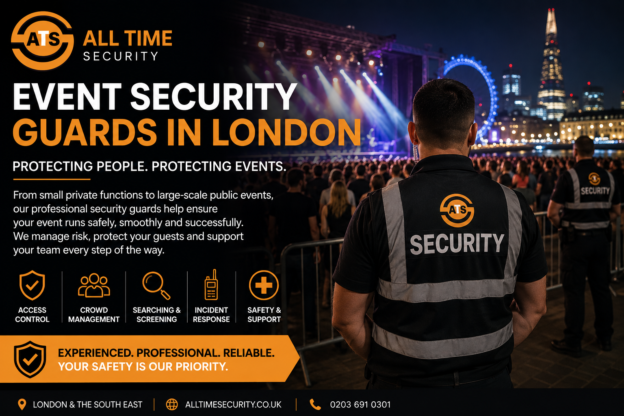
Event Security Guards in London: Why Professional Event Security Matters
London is one of the world’s great event cities.
Every week, the capital hosts concerts, festivals, corporate functions, sporting events, exhibitions, charity events, community celebrations, private functions and major public gatherings attracting anything from a few hundred visitors to tens of thousands.
Behind every successful event is an enormous amount of planning.
Visitors may notice the stage, entertainment, catering and atmosphere. What they should rarely have to think about is the security operation working quietly around them.
Yet professional event security guards in London can be one of the most important elements of a successful event.
Security officers help control access, manage crowds, protect staff and visitors, identify suspicious behaviour, respond to emergencies and deal professionally with incidents before they become larger problems.
Good event security is not simply about responding when something goes wrong.
It is about creating the conditions that help prevent things going wrong in the first place.
For event organisers across London, choosing the right security company can therefore affect far more than security alone.
It can influence safety, customer experience, reputation and ultimately the success of the entire event.
Why Event Security in London Requires Specialist Planning
London creates some unique challenges for event organisers.
The capital has a huge and diverse population, an extensive public transport network and some of the country’s busiest entertainment, sporting and commercial districts.
An event in Westminster may have completely different security requirements from a festival in a large park, a corporate function in Canary Wharf, a sporting event near Wembley or an exhibition in East London.
There is no single security plan that works for every event.
Location, attendance, event type, alcohol, operating hours, age profile, ticketing arrangements, previous incidents, transport links and the physical design of the venue can all change the level of risk.
That is why professional event security should ideally begin before the first visitor arrives.
Experienced security providers work with organisers to understand how the event will operate, where vulnerabilities may exist and what security resources are appropriate.
The objective should never simply be:
“How many security guards can we put on site?”
A much better question is:
“What risks do we need to manage, and where can trained security personnel make the greatest difference?”
Event Security Starts Before the Event
One of the biggest misconceptions about event security is that the service begins when officers arrive for their shift.
The strongest security operations begin much earlier.
Before deployment, organisers and security managers may need to consider entrances and exits, emergency routes, crowd movement, restricted areas, ticketing procedures, vehicle access, staff entrances, contractor access and emergency response arrangements.
Large or complex events may require detailed deployment plans identifying where each officer will be positioned and what their responsibilities will be.
Security teams also need clear communication.
Who is the event manager?
Who has authority to make operational decisions?
How does security communicate with medical teams?
What happens if an entrance needs to be closed?
Where is the event control point?
Who contacts emergency services?
These arrangements need to be understood before an incident occurs.
When security becomes part of the wider event-management team rather than an isolated service, the entire operation becomes stronger.
Controlling Who Enters the Event
Access control is one of the most visible responsibilities of event security guards.
Depending on the event, officers may support ticket checks, guest-list verification, accreditation, staff entrances, VIP areas, backstage areas and restricted zones.
But access control is about much more than confirming somebody has a ticket.
Security personnel need to monitor behaviour around entrances and recognise when something does not look right.
They may also need to deal with people attempting to enter without permission or visitors refusing to comply with entry conditions.
The Security Industry Authority distinguishes between basic stewarding tasks and activities that require an appropriate SIA licence. For example, checking that somebody has paid for entry may not itself require a security licence, but refusing somebody entry or requiring them to leave can become a licensable security activity.
This is an important distinction for organisers.
Using general event stewards where a situation actually requires trained and appropriately licensed security personnel can create unnecessary risk.
Bag Searches and Entry Screening
Some events require bag searches or other forms of entry screening.
The purpose is not simply to make entry more difficult.
Effective searching can help prevent prohibited or potentially dangerous items from reaching the event itself.
This may include alcohol where prohibited, glass, weapons or other items restricted by the event’s conditions of entry.
Search procedures need to be professional, consistent and respectful.
Current SIA guidance confirms that licensed door supervisors may conduct consensual bag searches in accordance with the relevant assignment instructions for the venue or security company.
Poorly organised searches can create queues and frustration.
Well-planned searches become part of an efficient entrance system.
That requires sufficient personnel, good communication and clear procedures so that visitors understand what is expected before they reach the security checkpoint.
Crowd Management Is About Understanding People
Crowds are not automatically dangerous.
But crowd behaviour can change quickly.
At an event, large numbers of people may move simultaneously when gates open, an artist appears, a match finishes, refreshments close or transport services begin filling up.
Security teams need to understand where pressure might develop.
An experienced officer may notice that an entrance is becoming congested long before it becomes a serious problem.
Barriers can be repositioned.
Visitors can be redirected.
Additional lanes can be opened.
Information can be communicated.
A relatively small intervention at the right time can prevent a considerably larger issue later.
Government careers guidance for door supervisors specifically identifies crowd and queue management, searching, incident response, patrolling and working alongside police, first aiders and venue managers as common aspects of the role.
This demonstrates an important point:
Event security is fundamentally about people management.
Customer Service Is Part of Good Security
Some organisations still imagine the ideal security officer as somebody intimidating standing with folded arms.
That approach is outdated.
Modern event security is heavily customer focused.
For many visitors, a security officer may be the first member of the event team they encounter.
People ask security officers questions constantly:
Where is the entrance?
Which queue should I join?
Where are the toilets?
Can I take this inside?
Where is first aid?
How do I find my seat?
An officer who is calm, approachable and knowledgeable improves the experience before the visitor has even entered the main event.
Customer service and security are therefore not opposites.
They reinforce each other.
The National Careers Service lists patience, calmness under pressure, customer-service skills and strong verbal communication among the core skills required for door supervisors.
For All Time Security, this is particularly important.
A professional officer should know when to be friendly, when to be firm and when circumstances require immediate action.
Preventing Conflict Before It Escalates
Anywhere large numbers of people gather, disagreements can occur.
Alcohol can increase the likelihood at some events, but disputes can also develop around queues, tickets, seating, restricted areas or simply misunderstandings.
The best security officers do not automatically turn minor disagreements into confrontations.
They attempt to resolve them.
Body language, communication and situational awareness are extremely important.
An experienced officer can often recognise when somebody is becoming frustrated and intervene before that frustration turns into aggression.
This is why de-escalation is such an important part of professional event security.
Physical intervention may occasionally become necessary where there is a genuine risk to people, but it should never be the starting point.
The best intervention is often the one that prevents an incident from developing at all.
Protecting Event Staff as Well as Visitors
Security planning understandably focuses heavily on the public.
But organisers also have employees, contractors, performers, catering staff, technical teams and volunteers working behind the scenes.
They need protection too.
Public-facing employees can sometimes become the target of aggression when visitors are unhappy about entry, alcohol service, ticketing or event rules.
Security personnel provide support when a normal customer-service interaction becomes threatening.
They can also help protect restricted areas containing valuable equipment or sensitive information.
At concerts and entertainment venues, that might mean securing backstage areas.
At exhibitions, officers may protect exhibitors and equipment.
At corporate functions, access to private or VIP areas may need to be carefully controlled.
Effective event security therefore protects people, property and operations simultaneously.
Emergency Response and Communication
Even well-planned events can experience emergencies.
A visitor might become seriously ill.
A fire alarm may activate.
There may be a suspicious package.
A child might become separated from their family.
An area may need to be evacuated.
In rare circumstances, a serious security incident may occur.
Professional security officers can help create order during these situations.
They may assist with keeping emergency routes clear, directing visitors, securing areas, communicating with management and supporting police, ambulance or fire services.
Good communication systems become especially important.
Officers should understand where event control is located, which radio channels are being used and who has authority to make major operational decisions.
When thousands of people are present, confusion can create additional risk.
Clear command structures help prevent that.
Counter-Terrorism and Protective Security at Events
Event organisers also need to consider wider protective-security risks.
Counter Terrorism Policing’s ProtectUK guidance specifically provides advice for organisations responsible for venues, public spaces and major events. During summer 2026, Counter Terrorism Policing again encouraged event organisers and venues to promote vigilance, working with organisations and major destinations including Wimbledon, Wembley, The O2 and Tottenham Hotspur.
This does not mean every event needs to operate like a high-security site.
Security measures should always be proportionate to the risk.
But officers should be alert to unusual behaviour, unattended items, suspicious activity and potential vulnerabilities around the event.
Protective security can involve much more than searching visitors.
Vehicle access, perimeter security, CCTV, emergency planning, staff awareness and communications can all form part of a wider strategy.
The goal is preparedness rather than fear.
Martyn’s Law and the Future of Event Security
Event organisers should also be aware of the Terrorism (Protection of Premises) Act 2025, commonly known as Martyn’s Law.
The legislation received Royal Assent in April 2025 and is intended to improve protective-security preparedness at qualifying premises and events. The Home Office published statutory guidance in April 2026, although the substantive requirements of the Act have not yet commenced. The Government has stated there will be an implementation period of at least 24 months from Royal Assent.
Under the framework described in the guidance, qualifying events and larger premises are expected to have greater protective-security responsibilities once the relevant provisions come into force.
The current guidance identifies enhanced requirements for larger premises and qualifying events where 800 or more people may be present, while standard-tier qualifying premises generally concern capacities between 200 and 799.
Measures considered for larger venues and events may include appropriate CCTV, search policies and vehicle checks, depending on the circumstances and what is reasonably practicable.
For event organisers, the lesson is straightforward.
Security planning should increasingly be seen as an integral part of event management, not something arranged a few days before opening.
Stewards and Security Guards Are Not the Same Thing
Events often need both stewards and security personnel.
The roles can complement each other, but they are not interchangeable.
A steward might provide directions, help visitors find seats or provide general information.
Certain activities—such as refusing entry, removing individuals or undertaking other regulated security functions—can require appropriately licensed personnel.
Understanding this distinction is important when planning staffing.
A large number of unlicensed stewards does not necessarily replace a smaller number of properly trained security professionals where licensable security duties are required.
The correct mix depends on the event.
Professional security companies should be able to help organisers understand which duties require which personnel.
Event Security for Different Types of London Events
One of the reasons event security requires specialist planning is the sheer variety of events held across London.
A corporate conference may require discreet front-of-house security, guest verification and protection of restricted meeting areas.
A music event may require searches, crowd management, stage protection and alcohol-related incident management.
A festival might require perimeter security, multiple entrances, mobile response teams and overnight protection.
A sporting event may involve large crowd movements before and after the event as well as segregation or controlled areas.
A private function may prioritise guest-list management and preventing unauthorised access.
Community events and public celebrations may need a particularly friendly, approachable security presence while still maintaining robust procedures behind the scenes.
There is no sensible one-size-fits-all package.
The security solution should reflect the event itself.
How Many Security Guards Does an Event Need?
This is one of the most common questions event organisers ask.
Unfortunately, there is no responsible universal answer such as “one guard for every 100 visitors”.
Attendance numbers matter, but they are only one part of the calculation.
An event for 1,000 seated corporate guests may create very different risks from an event for 1,000 people where alcohol is served and crowds are standing close to a stage.
Factors to consider include venue layout, number of entrances, alcohol, crowd profile, event history, operating hours, restricted areas, emergency exits, search requirements and the nature of the entertainment.
This is why a security risk assessment is so valuable.
It allows resources to be placed where they are actually required instead of simply choosing an arbitrary staffing number.
Local Event Security Across London
Security requirements can also vary depending on where in London the event takes place.
Central London venues around Westminster, the City, Southwark and Camden often operate in extremely busy environments where pedestrians, transport networks, tourists and neighbouring businesses must all be considered.
Major event districts around Wembley, Stratford and Greenwich can experience large movements of visitors arriving and leaving within relatively short periods.
Outer London venues in areas such as Croydon, Hillingdon, Barnet, Ealing or Hounslow may have different considerations around vehicles, parking, perimeter access and transport.
A security company familiar with London can therefore bring useful local understanding to the planning process.
The capital’s event environment is highly coordinated, involving organisers, local authorities and, depending on the event, organisations such as the Metropolitan Police, fire services, licensing teams and safety advisory groups. London City Hall has previously described venue and event safety in the capital as involving numerous regulatory and public-safety bodies working across different responsibilities.
Choosing Event Security Guards in London
Price will always form part of event planning.
But security should not be selected solely on the cheapest hourly rate.
Organisers should look at the structure behind the officers being supplied.
Are licences verified?
How are officers selected?
Are they experienced in events?
Who supervises them?
Is there an operational manager?
What happens if somebody fails to attend?
How are incidents reported?
Are officers properly briefed before deployment?
Can the company respond if staffing requirements suddenly change?
These questions tell you considerably more about a security provider than the hourly price alone.
Professional event security depends on preparation, management and accountability.
How All Time Security Supports Events Across London
At All Time Security, we provide professional security personnel for events throughout London and the wider South East.
Our approach begins by understanding the event rather than simply providing a number of officers.
Depending on the requirement, our teams can support organisers with access control, crowd management, searching, front-of-house security, restricted-area protection, incident response, mobile security and event security planning.
We understand that security officers also represent the event itself.
They need to be professional, presentable and approachable while remaining confident enough to respond when a genuine security issue develops.
For event organisers, that balance matters.
Visitors should remember the event.
Not the security operation that made it possible.
Final Thoughts: Good Event Security Protects the Experience
Successful event security is rarely dramatic.
It is organised.
It is preventative.
And much of it happens without the public ever noticing.
The entrance operates smoothly.
Queues remain controlled.
Visitors know where to go.
Potential problems are identified early.
Staff feel supported.
Restricted areas remain secure.
And when something unexpected happens, trained people are available to respond.
That is what professional event security should achieve.
For organisers searching for event security guards in London, the objective should not simply be finding people to stand at entrances.
It should be finding a security partner capable of understanding the event, identifying its risks and helping create a safe environment in which everybody else can concentrate on enjoying it.
Because ultimately, great security should not distract from an event.
It should help make the event possible.
