

Businesses today face more security challenges than ever before. From theft and vandalism to unauthorised access, cyber-physical threats and workplace violence, organisations of every size must take a proactive approach to protecting their people, property and reputation.
Unfortunately, many businesses only review their security after something has already gone wrong. By then, the financial loss, operational disruption and reputational damage may already be significant.
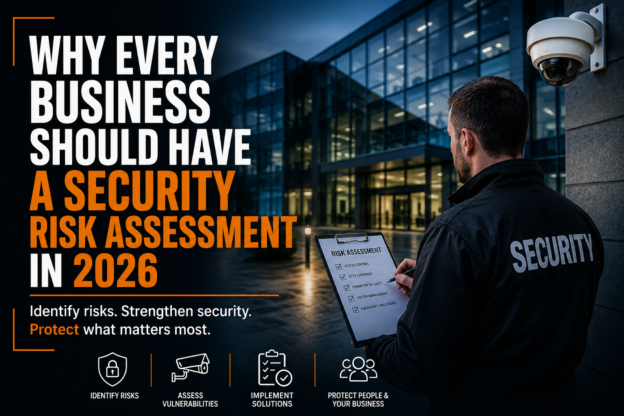
A professional security risk assessment helps businesses identify vulnerabilities before they become costly incidents. Rather than reacting to problems, it enables organisations to strengthen their security, improve safety and reduce risk through informed planning.
Whether you operate a retail store, office, warehouse, construction site, school, healthcare facility or commercial premises, a security risk assessment is one of the most valuable investments you can make in protecting your organisation.
What Is a Security Risk Assessment?
A security risk assessment is a structured review of your premises, operations and procedures to identify potential threats and evaluate how well your existing security measures protect against them.
It looks beyond simply counting CCTV cameras or checking whether doors are locked.
Instead, it examines every aspect of your business that could affect safety and security, including physical access, visitor management, employee procedures, technology, emergency planning and operational risks.
The objective is straightforward:
Identify vulnerabilities before criminals or opportunists do.
Every business has different security requirements, meaning no two assessments should ever be identical.
A warehouse storing valuable stock will face different risks to a corporate office, while a retail store has different priorities from a construction site or educational facility.
Why Security Risk Assessments Matter More Than Ever in 2026
The security landscape continues to evolve.
Businesses now face increasingly sophisticated threats, including organised theft, trespassing, anti-social behaviour, vandalism and targeted criminal activity.
At the same time, organisations must balance security with customer experience, employee wellbeing and operational efficiency.
Modern security is no longer simply about locking doors at the end of the day.
It requires businesses to think strategically about how people enter buildings, how visitors are managed, how incidents are reported and how staff respond when something unexpected happens.
A professional assessment provides the insight needed to make informed decisions rather than relying on assumptions.
What Does a Security Risk Assessment Include?
A comprehensive assessment reviews the entire security profile of a business.
Areas commonly assessed include:
Physical Security
The condition of perimeter fencing, gates, doors, windows and other physical barriers.
Weak entry points are often identified as opportunities for opportunistic criminals.
Access Control
Who can enter your premises?
How are visitors managed?
Are contractors supervised?
Is access restricted to authorised personnel only?
Poor access control remains one of the most common weaknesses found during commercial security assessments.
CCTV Coverage
Security cameras are valuable—but only if they are positioned correctly, maintained properly and monitored effectively.
An assessment will identify:
- Blind spots
- Poor lighting
- Image quality issues
- Recording coverage
- Camera placement
Many businesses invest in CCTV only to discover after an incident that the footage is unusable.
Alarm Systems
Are alarm systems suitable for the premises?
Who responds when an alarm activates?
Is there a clear key holding procedure?
Professional alarm response forms an important part of an overall security strategy.
Visitor Management
Every visitor entering a business should be accounted for.
An assessment reviews:
- Reception procedures
- Visitor identification
- Contractor management
- Delivery processes
- Emergency evacuation records
These procedures protect both people and confidential information.
Staff Awareness
Even the most advanced security systems can be undermined by poor security awareness.
Employees should understand:
- Access procedures
- Reporting suspicious behaviour
- Emergency protocols
- Lone working procedures
- Confidential information handling
Security is everyone’s responsibility.
The Cost of Not Having a Security Risk Assessment
Many organisations assume their existing security arrangements are sufficient because they have never experienced a major incident.
Unfortunately, criminals often exploit weaknesses that businesses don’t realise exist.
The consequences can include:
- Theft of stock or equipment
- Business interruption
- Property damage
- Higher insurance costs
- Loss of confidential information
- Reduced staff confidence
- Damage to customer trust
In many cases, the financial cost of a single incident far exceeds the cost of implementing preventative security improvements.
Security Is About More Than Preventing Crime
One of the biggest misconceptions is that security only exists to stop criminals.
In reality, effective security supports the wider operation of a business.
A well-managed security strategy helps organisations:
- Protect employees
- Safeguard visitors
- Improve customer confidence
- Meet health and safety responsibilities
- Demonstrate professionalism
- Support business continuity
- Protect company reputation
Visible security measures also create reassurance.
Customers, employees and visitors often feel safer when they know appropriate security procedures are in place.
Different Industries Face Different Risks
Every sector requires a tailored approach.
Offices
Corporate environments benefit from controlled access, visitor management and reception security.
Retail
Retailers face shoplifting, aggressive behaviour, cash handling risks and stock theft.
Visible security officers can deter crime while providing excellent customer service.
Construction Sites
Construction sites remain attractive targets due to valuable tools, machinery and materials.
Security assessments often focus on perimeter protection, out-of-hours patrols and access control.
Warehouses
Large storage facilities require effective perimeter security, vehicle access management and regular patrols to protect valuable inventory.
Schools and Educational Facilities
Safeguarding, visitor management and emergency planning are key priorities.
Healthcare
Hospitals and healthcare settings require security measures that protect staff and patients while maintaining a welcoming environment.
Common Security Weaknesses Businesses Overlook
During commercial assessments, certain issues appear repeatedly.
These include:
- Unlocked side entrances
- Shared access codes
- Poor exterior lighting
- Unmonitored loading bays
- Inadequate visitor records
- Blind spots in CCTV coverage
- Lack of emergency procedures
- No alarm response plan
- Employees holding doors open for unknown individuals
- Valuable equipment left visible overnight
Individually these may appear minor.
Combined, they can create significant vulnerabilities.
Technology Is Only Part of the Solution
Modern security technology has transformed the industry.
Businesses now have access to:
- AI-enabled CCTV
- Remote monitoring
- Smart access control
- Number plate recognition
- Intelligent alarm systems
- Visitor management software
These systems provide valuable information.
However, technology alone cannot replace professional judgement.
Experienced security officers remain essential for:
- Responding to incidents
- Managing conflict
- Assisting visitors
- Making informed decisions
- Providing reassurance
- Protecting people
The strongest security strategies combine technology with trained personnel.
The Benefits of Working with a Professional Security Company
An experienced security provider doesn’t simply supply guards.
They help businesses understand risk and develop practical, proportionate security solutions.
Professional security companies provide:
- Site-specific risk assessments
- Tailored security recommendations
- Experienced SIA licensed officers
- Mobile patrols
- Reception security
- Key holding and alarm response
- Event security
- Ongoing support and reviews
Security should evolve as your business changes.
Regular reviews ensure your protection remains effective.
Why Choose All Time Security?
At All Time Security, we believe prevention is always better than reaction.
Every organisation is different, which is why we begin by understanding your business, identifying potential risks and recommending security measures tailored to your specific requirements.
Our experienced, SIA-licensed security professionals provide a wide range of services, including:
- Security Guards
- Mobile Patrols
- Key Holding & Alarm Response
- Door Supervision
- Reception & Concierge Security
- Construction Site Security
- Retail Security
- Event Security
- Security Dog Patrols
Whether you require a long-term security partner or support for a specific project, our focus is on delivering practical, professional solutions that protect your people, property and reputation.
Final Thoughts
Security isn’t simply about responding to crime—it’s about preventing opportunities for crime to occur in the first place.
A professional security risk assessment provides businesses with valuable insight into their current security arrangements, helping identify weaknesses before they become costly problems.
In an increasingly complex world, taking a proactive approach to security is no longer optional. It’s an essential part of responsible business management.
If you haven’t reviewed your security arrangements recently, now is the ideal time to assess whether your business is protected against today’s risks and prepared for tomorrow’s challenges.
Frequently Asked Questions
How often should a business carry out a security risk assessment?
Most businesses should review their security at least once a year or whenever there is a significant change, such as moving premises, expanding operations, refurbishing a site or following a security incident.
Is a security risk assessment only for large businesses?
No. Small businesses are often targeted because criminals assume they have fewer security measures in place. A risk assessment is valuable for organisations of all sizes.
Can a security risk assessment reduce insurance costs?
While every insurer is different, demonstrating robust security measures and proactive risk management may help when discussing insurance premiums or policy terms.
What happens after a security risk assessment?
The findings are typically presented in a report that identifies vulnerabilities, prioritises risks and recommends practical improvements. Businesses can then decide which measures to implement based on their operational needs and budget.
