


The way security companies are assessed and approved in the UK is set for one of its biggest changes in two decades.
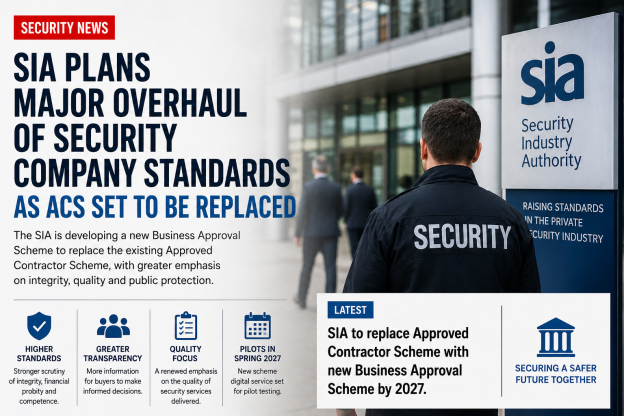
The Security Industry Authority (SIA) has confirmed that it is developing a new Business Approval Scheme (BAS) which will ultimately replace the existing Approved Contractor Scheme (ACS).
The change forms part of the regulator's new 2026–2029 strategy, with a much greater emphasis on the quality of security services, public protection, company integrity and giving organisations better information when choosing security suppliers.
According to the SIA's Strategic Plan for 2026–2029, the existing ACS has been operating since 2006. The replacement scheme is intended to introduce greater scrutiny of areas including integrity, financial probity, competence and quality. GOV.UK
For businesses across London and the UK that purchase security services, this could represent an important shift in how security companies are evaluated.
What Is the SIA Approved Contractor Scheme?
The Approved Contractor Scheme is currently the SIA's voluntary quality assurance scheme for private security companies.
Security businesses participating in the scheme are independently assessed against standards covering their operations and management. The SIA also carries out checks relating to those running businesses applying for approval, including areas such as identity, criminality, integrity and financial probity. GOV.UK
For organisations purchasing security services, ACS approval provides an additional level of assurance when comparing providers.
Importantly, the ACS remains the current SIA approval scheme at present. The new Business Approval Scheme is still being developed, so companies and security buyers should not treat the ACS as though it has already ended. The SIA's current plan is to develop the BAS service and prepare it for pilots in spring 2027. GOV.UK
Why Is the SIA Replacing the ACS?
The security industry has changed considerably since the ACS was introduced.
Security officers today may be responsible for far more than simply maintaining a physical presence at a premises.
Depending on the environment, their responsibilities can include access control, visitor management, emergency response, safeguarding, incident reporting, CCTV monitoring, public interaction and supporting wider protective-security measures.
The SIA says trust in the private security industry increasingly depends upon standards that support legitimate businesses and place public protection and protective security at the centre of operations. Its new strategy therefore proposes greater scrutiny of the quality of service being delivered rather than focusing purely on whether a business meets basic compliance requirements. GOV.UK
This is an important distinction.
A security company can technically provide licensed officers, but businesses purchasing security should also be considering how those officers are recruited, supervised, trained, supported and managed.
What Will the New Business Approval Scheme Look At?
The exact final design of the Business Approval Scheme is still being developed, but the SIA has already outlined its direction.
Its strategic plan says the new scheme will place greater emphasis on:
- Integrity
- Financial probity
- Quality
- Competence
- Public protection
- Different security business specialisms
- Quality of service delivery
The regulator also intends to introduce a more transparent public register providing buyers with more useful information about approved businesses, their services and their operations. GOV.UK
That could make it easier for facilities managers, procurement departments and business owners to compare security suppliers based on meaningful information rather than simply price.
Security Buyers Could Have More Information
This is potentially one of the most important developments for businesses purchasing security.
Security procurement can sometimes become heavily focused on hourly rates.
The cheapest quotation can appear attractive on paper, but the price of a security contract does not tell a buyer how effectively officers will be recruited, vetted, trained, supervised or supported once the contract begins.
The SIA specifically says that one of the intended outcomes of the Business Approval Scheme is to support security buyers in making informed purchasing decisions through greater transparency. GOV.UK
This complements the SIA's recently introduced Buyer's Charter, which is intended to encourage organisations to support good procurement practice and purchase quality security services.
For businesses in London, where security contracts can cover busy offices, shopping centres, construction projects, warehouses, residential developments and major events, choosing the right provider can have a direct impact on public safety and business operations.
Could Security Company Licensing Eventually Become Mandatory?
Possibly — but this is an important area where the distinction between current policy and future proposals needs to be clear.
The new BAS itself is being developed as the successor to the voluntary ACS.
Separately, the Government has been considering whether security businesses themselves should eventually require mandatory licensing.
This follows recommendations arising from the Manchester Arena Inquiry.
The Home Office's consultation on the relevant recommendations explains that one option would involve security businesses undergoing a comprehensive "fit and proper" assessment covering identity, criminality, integrity, financial probity and competence. However, the consultation considered several possible options, and mandatory business licensing remains subject to Government and ministerial decisions. GOV.UK
The SIA's 2026–2027 Business Plan states that the new BAS is being designed so that it could complement or transition alongside a future mandatory business-licensing regime if one is introduced. GOV.UK
So businesses should not interpret the proposals as meaning that mandatory security-company licensing has already been introduced.
It hasn't.
But the direction of travel is clearly towards greater scrutiny and accountability across the private security industry.
Why Has Business Regulation Become Such an Important Issue?
Individual security operatives undertaking licensable activity are already subject to SIA licensing requirements.
The challenge is that regulation of security companies themselves has historically been different.
The Home Office consultation following the Manchester Arena Inquiry highlighted concerns about the regulator's ability to oversee businesses themselves. It also noted industry concerns around issues including tax fraud, training fraud, illegal employment practices, labour exploitation and companies undercutting legitimate operators while potentially compromising standards. GOV.UK
This creates a wider problem for the industry.
Responsible security companies invest heavily in:
- Recruitment
- Vetting
- Training
- Supervision
- Management
- Insurance
- Compliance
- Employee welfare
- Quality assurance
Companies cutting corners can sometimes offer considerably cheaper rates.
For a buyer comparing quotations purely on price, those differences may not immediately be obvious.
That is one reason why stronger approval standards could benefit both professional security businesses and their clients.
Security Procurement Is Changing
The development of the BAS also reflects a broader change in the way organisations are being encouraged to purchase security.
Security should not simply be treated as another commodity.
If a cleaning supplier performs poorly, there may be inconvenience.
If a security provider performs poorly during a serious incident, the consequences can potentially involve people, property, business operations and public safety.
This is particularly important in environments such as:
- Corporate offices
- Construction sites
- Warehouses
- Retail premises
- Hotels
- Entertainment venues
- Public buildings
- Events
- Residential developments
Security buyers therefore need to look beyond the hourly rate.
What Should Businesses Ask a Security Company?
Whether a business operates in the City of London, Westminster, Canary Wharf, Southwark, Croydon, Hillingdon or elsewhere across the capital, procurement teams should understand exactly what they are purchasing.
Useful questions include:
Is the provider currently an SIA Approved Contractor?
The SIA maintains an official Register of Approved Contractors, allowing organisations to verify a company's current status.
How are officers vetted?
Businesses should understand the recruitment and screening procedures used before personnel are deployed.
What training is provided?
The SIA licence represents an important baseline, but individual contracts and environments may require additional site-specific training.
How are security officers supervised?
Clients should understand who manages the contract and how officer performance is monitored.
What happens if an officer is absent?
Reliable contingency arrangements are essential.
How are incidents recorded and escalated?
Good security requires clear communication and reporting procedures.
Does the provider understand your particular sector?
The security requirements of a construction project are very different from those of a corporate headquarters or retail environment.
What Does This Mean for London Businesses?
London contains some of the UK's most complex commercial security environments.
Large corporate buildings may receive thousands of visitors. Construction developments can contain valuable equipment and materials. Retail premises face theft and antisocial behaviour. Warehouses protect significant levels of stock. Entertainment venues must manage crowds while maintaining a positive customer experience.
For businesses operating in these environments, choosing the wrong security provider can create vulnerabilities rather than solve them.
The move towards stronger business standards should therefore be welcomed by organisations that already prioritise quality.
It should also encourage security buyers to examine their procurement processes.
Instead of simply asking:
"What is your hourly rate?"
buyers should increasingly be asking:
"What standards, management systems, training and quality controls are behind that hourly rate?"
That is a far more meaningful question.
The SIA Is Also Increasing Its Focus on Inspections
The regulatory changes are not limited to creating a new approval scheme.
The SIA's 2026–2027 Business Plan states that it intends to conduct 250 risk-led inspections of businesses supplying regulated security services, alongside broader work to improve business standards. GOV.UK
The regulator has also indicated that its future inspection approach will focus increasingly on the quality of security delivery, rather than viewing compliance as simply a pass-or-fail exercise. GOV.UK
That represents an important cultural change.
The question becomes not only:
"Is the business compliant?"
but also:
"Is it actually delivering good security?"
For clients, that is ultimately what matters.
What Happens Next?
The SIA's programme for 2026–2027 includes completing consultation work, testing the proposed BAS assessment methodology with existing approved businesses, publishing the final scheme and developing the new digital service and register.
The regulator aims to have the BAS digital application service ready for pilots in spring 2027. GOV.UK
Eventually, the SIA says the ACS will close and businesses will transition to the replacement scheme, but organisations should continue to use the existing ACS framework until that transition formally takes place. GOV.UK
All Time Security and Professional Standards
For organisations looking for professional security services, independent accreditation and regulatory standards can provide an important additional level of confidence.
All Time Security Ltd is currently listed on the official SIA Register of Approved Contractors, with approval covering Security Guarding and Door Supervision. SIA Services
As the security industry moves towards greater scrutiny, transparency and quality-based assessment, these principles will become increasingly important.
Professional security is not simply about supplying someone wearing a uniform.
It requires effective recruitment, management, supervision, training, communication and accountability.
For businesses throughout London, choosing a security partner that takes those responsibilities seriously can make a significant difference to the protection of employees, customers, property and operations.
Final Thoughts
The replacement of the Approved Contractor Scheme with the new Business Approval Scheme represents much more than a change of name.
The SIA describes the wider reset of security-business standards—and the possible future introduction of mandatory business licensing—as one of the most significant shifts in regulation of the private security industry since regulation began more than 20 years ago. GOV.UK
For reputable security companies, stronger standards should provide an opportunity to demonstrate the difference between quality security provision and services that compete primarily on price.
For security buyers, the message is equally important.
Ask more questions. Check accreditation. Look at management, training and quality—not simply cost.
As the new Business Approval Scheme develops, organisations purchasing security services will potentially have more information than ever before to help them make those decisions.
And ultimately, better-informed procurement should mean better security.


 AREAS
AREAS