


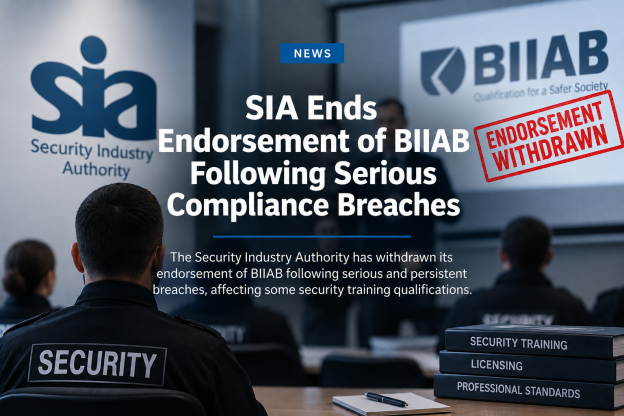
SIA Ends Endorsement of BIIAB Following Serious Compliance Breaches
The Security Industry Authority has withdrawn its endorsement of BIIAB, an awarding organisation that previously issued qualifications linked to SIA licences.
The decision came into effect in August 2026 and followed what the SIA described as “serious and persistent” breaches of its agreement with BIIAB. The move affects some people undertaking security training and highlights the importance of checking that qualifications are completed through properly recognised routes. Read the official SIA guidance on BIIAB. GOV.UK
What has happened?
BIIAB was one of the awarding organisations involved in providing qualifications used by people applying for SIA licences.
The SIA announced in July that it would end its recognition agreement with BIIAB after concerns were identified during unannounced inspections carried out as part of Operation RESOLUTE. Read the SIA announcement. GOV.UK
The regulator has since published guidance for people who may already have completed training, started a course or planned to undertake training through a provider approved by BIIAB.
What does this mean for security officers?
The impact depends on when an individual completed their qualification.
The SIA has confirmed that qualifications awarded by BIIAB before the cut-off can still be accepted in certain circumstances, while it will not accept qualifications granted by BIIAB on or after 11 August 2026. Check the current SIA qualification requirements. GOV.UK
Anyone currently undertaking training or planning to start a course should therefore check the latest SIA guidance carefully.
Why training standards matter
Security officers often work in environments where they may need to deal with emergencies, conflict, vulnerable people or members of the public.
For this reason, proper training is a fundamental part of maintaining standards across the private security industry.
Businesses purchasing security services should not only confirm that officers hold a valid SIA licence but should also consider the wider standards maintained by their security provider.
This can include:
- ongoing officer training
- licence monitoring
- right-to-work checks
- regular supervision
- site-specific induction
- refresher training
- accurate training records
What should security companies do?
Security providers should make sure that qualifications and training used for licensing purposes meet current SIA requirements.
Companies may also want to review internal records to ensure officers remain properly licensed and that future training is being delivered through recognised awarding organisations.
The SIA currently lists the awarding organisations whose qualifications it accepts and provides guidance for both learners and training providers. View the SIA’s guidance on licence-linked training. GOV.UK
For individual officers planning further training, checking the status of both the training provider and awarding organisation before enrolling is particularly important.
A wider focus on standards
The decision also comes at a time when greater attention is being placed on standards within the private security industry.
Holding an SIA licence is an essential requirement for many frontline security roles, but professional security involves more than licensing alone.
Good providers should also be able to demonstrate effective recruitment, training, supervision and ongoing compliance.
For clients, particularly those operating higher-risk sites, selecting a provider with strong compliance procedures can reduce the risk of unsuitable or insufficiently trained personnel being deployed.
Maintaining confidence in the security industry
The action involving BIIAB demonstrates that qualification and training standards are being actively monitored.
The SIA has said that protecting the integrity of licence-linked training is important for both public safety and confidence in the private security industry. Read more about the regulatory action. GOV.UK
While the change primarily affects certain licence applicants and training providers, it sends a wider message across the sector: licensing, qualifications and training standards need to be properly managed.
Security companies and officers should therefore continue to monitor official SIA guidance and ensure their training and compliance arrangements remain up to date.