



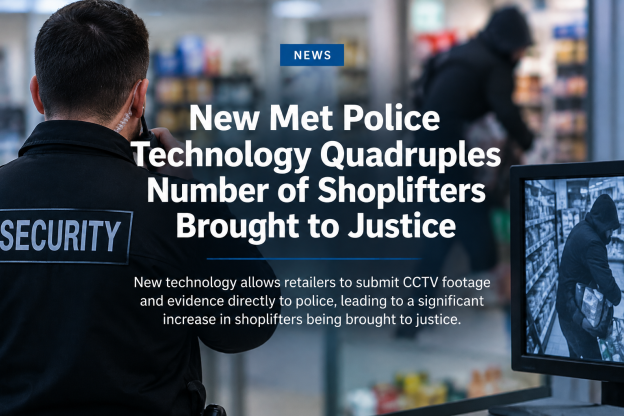
The Metropolitan Police has expanded new technology designed to tackle retail crime after trials showed a sharp increase in the number of shoplifters being brought to justice.
The system allows retailers to submit CCTV footage, witness statements and other evidence directly to police, significantly reducing the time officers have to wait for information. According to the Met, evidence that could previously take weeks to obtain can now be received within minutes. Read the Metropolitan Police announcement
The technology was initially piloted across six London boroughs and has now been expanded into a further eight, with more areas expected to follow. Major retailers including Tesco, Boots, Marks & Spencer and Greggs have already been using the system. See the Met’s update on the rollout
A stronger response to retail crime
Shoplifting and anti-social behaviour remain significant concerns for retailers, particularly where repeat offenders target the same locations.
The Met says that where shoplifting incidents have been submitted through the new system, 29.4% have resulted in a positive outcome, such as a charge, caution or another criminal disposal. View the Metropolitan Police figures
For retailers, quicker evidence sharing could make an important difference. Clear CCTV footage, accurate incident reports and witness information can help police identify offenders and build stronger cases.
Why security officers remain important
Technology can improve the way evidence is passed to police, but effective retail security still starts at the premises.
Professional security officers can help retailers by:
- monitoring entrances and high-risk areas
- identifying suspicious behaviour
- responding to incidents
- protecting staff and customers
- preserving CCTV and other evidence
- recording accurate incident details
- communicating with police
- identifying repeat offenders
The quality of the information collected following an incident can be particularly important.
A security officer who records the correct time, location, description of the offender, items involved and actions taken can provide useful evidence alongside CCTV footage.
CCTV and incident reporting
Retailers should also review whether their CCTV systems are providing clear and usable images.
Cameras should cover appropriate areas of the premises and recordings need to be stored and accessed in accordance with data protection requirements.
Security teams should also have a clear process for reporting incidents and preserving relevant footage.
The new Met system demonstrates how quickly good-quality evidence can now be shared when the right processes are in place. Read more about the Metropolitan Police retail crime system
Preventing incidents remains the priority
While improved police technology can help offenders to be identified and prosecuted, prevention remains an important part of retail security.
Visible security personnel can act as a deterrent while also providing reassurance to employees and customers.
Understanding when and where incidents occur can also help retailers make better security decisions. If repeated thefts take place at particular times or locations within a store, patrols, CCTV monitoring or officer positioning can be adjusted accordingly.
A more joined-up approach
The expansion of the Met’s technology highlights the importance of closer cooperation between retailers, security teams and police.
Retail security is increasingly about combining trained personnel, effective CCTV, accurate reporting and information sharing.
For businesses experiencing repeated theft, anti-social behaviour or threatening behaviour towards staff, reviewing existing security arrangements can help identify weaknesses before incidents become more serious.
The Met’s results suggest that faster evidence sharing can make a real difference — but the quality of that evidence still depends heavily on what happens at the premises when an incident occurs.