


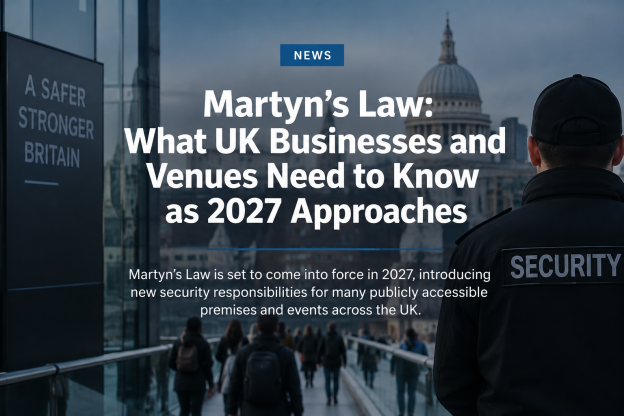
Martyn’s Law is moving closer to becoming a practical reality for thousands of businesses, venues and organisations across the UK.
Formally known as the Terrorism (Protection of Premises) Act 2025, the legislation is intended to improve preparedness for terrorist attacks at publicly accessible premises and events. It is commonly known as Martyn’s Law in memory of Martyn Hett, one of the 22 people killed in the Manchester Arena attack in 2017. Read the government guidance on Martyn’s Law.
The legislation is not yet in force, but the Security Industry Authority (SIA) is preparing for implementation in 2027. The SIA will become the regulator responsible for supporting organisations, receiving notifications, carrying out inspections and taking enforcement action where necessary. See the SIA’s guidance on its role as regulator.
Which premises could be affected?
Martyn’s Law is expected to apply to a wide range of publicly accessible locations, including shops, shopping centres, hotels, pubs, bars, clubs, entertainment venues, stadiums, festivals, places of worship and transport hubs.
The requirements will vary depending on the type and capacity of the premises. This is important because the legislation is intended to be proportionate. A small venue will not necessarily face the same requirements as a large stadium or major event space.
Businesses should therefore review the official guidance rather than assume they are either automatically included or excluded. View the government’s Martyn’s Law guidance.
What should businesses be doing now?
There is currently no requirement to register with the SIA because the legislation has not yet commenced. However, businesses that believe they may fall within scope can start reviewing their existing security and emergency procedures.
Areas worth considering include:
- entrances and exits
- visitor management
- access control
- emergency evacuation procedures
- staff responsibilities during an incident
- CCTV coverage
- suspicious activity reporting
- communication with emergency services
- incident reporting
- staff training
The aim should not be to introduce unnecessary security measures, but to understand where weaknesses exist and how they could be improved.
The role of professional security
Security officers can form an important part of a wider protective security plan. Depending on the site, this may include managing access, monitoring entrances, controlling visitors, supporting CCTV, identifying suspicious behaviour, assisting with evacuations and responding to incidents.
However, businesses should not assume that simply employing security guards means they are automatically compliant with Martyn’s Law. Responsibility remains with the organisation or person legally responsible for the premises. Read more about responsibilities under Martyn’s Law.
Training will also be important
Good security is not only about guards, cameras and barriers. Staff need to know what to do when something goes wrong.
Simple measures such as clear emergency procedures, defined responsibilities, regular staff briefings and effective communication can make a significant difference. Businesses may also benefit from reviewing whether employees know how to report suspicious behaviour and what actions to take during a serious incident.
Why early preparation makes sense
Waiting until the legislation is in force could make compliance more difficult.
Starting early gives businesses time to review their current arrangements, identify gaps and introduce sensible improvements gradually. In many cases, better procedures, clearer communication and improved training may provide as much value as physical security changes.
As 2027 approaches, Martyn’s Law is likely to become an increasingly important issue for UK businesses and venues. Organisations that begin reviewing their security arrangements now will be in a stronger position to respond when the final requirements come into effect.